vendredi 13 mars 2020

Improving Hyrule Warrior’s giant bosses.


Koei Tecmo’s Warriors series nowadays is mostly a tactical beat them up game with simple controls that allow players to defeat hordes of enemies in order to take on a battlefield’s objectives. The tactical aspect differs from game to game, but it generally entails taking down specific enemies, and capturing or defending select locations. Even then, this is a very reductionist take because there is far more to these games. The default normal mode being far too easy and being easily brute-forced tends to be the reason that the average consumer often sees this series as “brainless”. On harder difficulties, enemy generals can dish out serious damage if you do not dodge, and they are far more aggressive, for example.


The series started off with notable Chinese historical figures as playable characters (Dynasty Warriors), but an offshoot was created from it featuring notable historical figures of the Japanese unification wars (Samurai Warriors). Then multiple offshoot were made to capitalize on various franchises like Gundam, Persona 5, Fire Emblem, and of course, The Legend of Zelda.


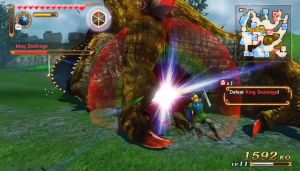
In these offshoots, Omega Force tries to include elements from the franchise they are basing the game on. For Zelda, they tried use multiple aspects, including using the right item to break a boss’ guard. That includes throwing a bomb into King Dodongo’s gullet, or shooting at Gohma’s eye with an arrow. Those boss battles feel very “Zelda”, but I believe that they are inherently flawed in their execution.


The issue comes with how said bosses move. In Zelda games, bosses tend to telegraph their attacks, and as such, you can use the right item for the situation and beat the boss. The boss in end of itself is a puzzle to solve. The issue with Hyrule Warriors is that they try to replicate that wait and react approach to combat, but there is no real pace to the battle. In Ocarina of time, King Dodongo has a fixed set of behaviours. He’d roll around, and then when he is done, he’d prepare for a fire-breathing attack. In Hyrule Warriors, there is no set pattern. The boss will use a move randomly from a pool of attacks in its moveset. As such, since you almost do no damage when not exploiting their weakness, if you are caught in a situation where you get unlucky RNG, you could be stuck waiting for a very long time for the enemy to show their weak spot. While rare, I have been in situation where I had to run circles around the enemy for over five minutes in the Wii U version. The 3DS and Switch versions thankfully add a system where you get more magic meter if multiple playable allies congregate around the boss. You can use the magic meter to force a weakened state, and that circumvents some of the issue. However, what happens if you have only one playable character for that scenario? And even with this set in place, it still takes a considerable amount of time to build up.


In terms of pacing, having to run circles around an enemy that simply refuses to do the right action heavily slows down progress. It also does not help that it adds a random element that can actually impede your progress. High score rewards are locked behind getting a good time, the RNG can have a significant effect on whether you get an A rank or a B Rank.


The first thing I would consider revising is attack patterns. I see no problems with a randomized set of attacks, but when it comes to the attack necessary to take these bosses down, I would implement a timer, which would force these bosses to use those said attacks after a set amount of time elapsed since the last time it was used. By doing this, you are reducing the amount of time spent running around the enemy waiting for the right opportunity.


You could also revise how much damage bosses take when the weakness is not taken advantage of. You technically do damage to bosses that are not in a prone state, but the amount of damage is extremely small, which makes a full combo barely even show any difference on their health bar. It could be possible to slightly increase the amount of damage that normal attacks have on a boss while still making guard breaks the optimal way to cause damage. This would make it so that actually attacking between guard break opportunities to cause some nice chip damage is not a waste of time. In a small way, this would keep the player engaged in the action. Mind you, I appreciate why they made the choices that they did, and they actually made improvements to their systems in the re-releases. The prime example I would list is the Imprisoned boss battle. In the original, the imprisoned would stop taking damage beyond half HP. In other words, no matter how much damage you would do, the Imprisoned would stop taking damage beyond the half HP threshold and start chasing you down. It would only begin taking damage again at the end of the chase. By removing that limitation in the remaster, it makes taking the Imprisoned down far less tedious.


All in all, Hyrule Warriors is a fantastic game with massive amounts of good content. It treats the game series with incredible reverence, and the passion shows. It is unfortunate that Omega Force does not always show that level of commitment to some of their other projects, like with Fire Emblem Warriors. Nevertheless, I would love to see a sequel with revised boss mechanics that can be more reliably taken-down. Challenge is welcome, but it also should not be a game of chance and grueling wait. This criticism comes from a place of love, as someone who played hundred of hours of this game.

vendredi 28 février 2020

The case for fixed level ups in Fire Emblem


The case for fixed level ups in Fire Emblem


When you are evaluating the viability of a unit in Fire Emblem, there are many factors you must consider: How long they are available, their weapon ranks, their class, etc… However, if we were to oversimplify things, we could just talk about base stats and stat growths.


Base stats are the stats that a characters starts with. They are important to determine the immediate usefulness of a character. A character with very high base stats will be useful right away. If their base stats are high considering their level, it actually helps their long-term viability as well. If you get a level 10 character with nearly maxed strength and speed, it does not matter if they do not level these stats often; they are already viable. These units tend to be reliable, and some players would argue that choosing reliable units is the way to go, as they are less tedious to make use of. They would argue that a character with low base stats could technically become good but at the cost of a lot of investment put into them, and it is not necessarily always going to work out in your favour.


Base growth determines a character’s chance of getting an increase in one of their stats. A 70% strength growth means that most of the time, they would be likely to gain more strength, but that is a 70% RNG roll every single level up. That means that it would be technically possible to roll very poorly on some runs, and great in others. High growth units that have many levels to go have a lot of potential, but potential does not always lead to results. I have seen playthroughs of Path of Radiance where Ike, a unit that tends to have a very high strength growth, where Ike had gotten only 4 strength level ups during the entire game. It is very unlikely, but it can happen.


                                                               Showing the variance:


This amount of variance has many implications, game design-wise. On one hand, it means that every playthrough will be different. Perhaps some characters will be very RNG-blessed and simply carry your run on one playthrough, while in another run, your MVP might be completely different. It leads to a lot of variety, where every playthrough is different than the last. However, this also means that in terms of game-balance, the developers must consider the RNG as a factor when designing maps.


Imagine that you make a boss with very high defense that only your main character can defeat. However, your character just didn’t level strength enough, and just does 0 damage to said boss. You are now locked in a no-win situation where you just cannot continue your run, no-matter what. The game has to be designed around multiple scenarios, where they must consider all sorts of results. This is why they tend to give very powerful units and tools to the player at various points in the games, in order to allow the player to progress in the worst possible circumstances. In FE 7, you get Marcus to help newbies, and Isadora joins much later to help in the case you might have lost Marcus. Then Athos is given to you on the last chapter in case you have nothing to defeat the final boss with.


However, in a game where you have less room for random variance, you can create far more intentional map-design. In Shadows of Valentia, the DLC maps were centered on a selected few units that had fixed levels and equipment. It led me to more effectively trade weapons and items between characters in clutch moments, or using a character’s abilities to their fullest. In the Cindered Shadows DLC for Three Houses, having more limited room to grow let them make maps taking advantage of the abilities of the set characters. While you could level up, the amount of levels you could obtain between the start and end of the DLC and the start of the main story to its end-game was much lower. This led to some creative map ideas that the main game could not have pulled off. In some cases, the damage my characters would do would be flush with the enemy’s HP on hard mode. Because the game knew you have to have a flier, one map made use of that fact by putting forests in front of your objective.


The fact is that with a fixed-level-up system, the developers would have a far better idea as to what the average stats of a player’s characters on a given map would be, and they could balance levels around that, adding a bit of a puzzle element to the maps.


Now, I am not saying that this is what they should do, but I very much enjoy those smaller Fire Emblem experiences that make stat variations less of a factor. I am aware that this has become a staple of Fire Emblem, but if anyone were to make a Fire Emblem-type game with a different spin, it may be an option to consider.

Rune Factory; a different kind of time waster.

Games like Animal Crossing or Harvest Moon have always been games that a subset of gamers can really get into, and their popularity has increased with the influx of more female gamers. Yet I often see a lot of people, me included, who just can’t get into these game, no matter how open they keep their minds. It may be because some people enjoy a more communal and relaxing playstylw, as opposed to some needing clearer goals and direction.


In a sense, I like feeling like I am progressing, building up to something, but those two games do not have a definite ending. You can’t « beat » Animal Crossing or Harvest Moon. You jus tplay until you are bored of it. I have many games to play and too little time, so the prospect of getting lost for years on one game doesn’t appeal to me. Yet, I enjoy Rune Factory, an offshoot of Harvest Moon, and I’ve always wondered why. I think I came up with an answer.


Rune Factory lets you manage your own farm, foster relationships, and just relax, but it also has a few differences to consider. Rune Factory has an actual story, combat, and dungeon-crawling. It allows the player to break the monotony of farming with exploration, and an unfolding narrative. It is hardly the deepest narrative, but it is something to work towards, and the life sim aspect becomes something you can use to immerse yourself in the world between story beats.  There is an end goal, and a definitive ending. While you can play past the main story, it gives you a good stopping point if you require it.


Rune Factory brought someone like me in, and it is in large parts because of the combat. It didn’t need to be great, just serviceable enough to break the monotony. If combines the farming with dungeon crawling by allowing the player to farm little plots of land in dungeons in order to get more energy to carry on further. Since your character can get tired, it is important to manage their stamina, albeit, they will use less and less stamina the more they engage in certain things. It is possible to brute-force the game through fighting a lot and then using little to no stamina in battle.


The game accomodates people who want goals to strive towards, and it isn’t that I think that Harvest Moon or Animal Crossing are bad games, but Rune Factory has achieved a happy medium between the two types of gamers that I find very interesting. This si why I prefer Dragon Quest Builders to Minecraft for instances.


Rune Factory is a franchise that deserves more attention, and after nearly dying once due to the closure of Neverland, I am happy to see it back (now can I have Lufia again?)

mercredi 19 février 2020

Adressing criticism in the Smash community


I have been part of the Smash community for a very long time, and I have seen it all from the start. There has always been a divide with how people play Super Smash Bros. Some prefer it as a party game, while others gravitated towards its unique mechanics to test the limits of their skills. There have been multiple itterations in the franchise, some more deep or technical than others, and they all played very differently. This also means that people may have very different preferences when it comes to which kind of smash game they prefer. I personally have a preference for Project M, a mod that takes a lot of its core mechanics from Melee, which is arguably the fastest and most responsive game in the series.


Over the years, it has dawned on me that whenever people ask me about the newest smash game, and I respond not really being into the newer games, I am often met with very abrasive responses. I immediately get branded as an « elitist » for merely prefering Project M and Melee over latest iterations. At this point, I haven’t even said anything negative at all. I just stated a mere preference. Often, this ends up in a heated debate about how Melee fans are horrible and stubborn and refuse to try new things… even if I played several hours of the newest game to come to the conclusion that I still prefer Project M over it. These experiences have been accumulating over the years, to the point where I am wary of mentioning my Smash preferences publicly. But honestly, this shouldn’t be happening. There is nothing wrong with having an oppinion.


The argument I often get is that by criticizing a game, I am attacking its fans by extension. That notion is preposterous, as one can dislike a certain thing, idea or concept without disrespecting those that like them. I am not very fond of mayonnaise, and have choice words for restaurants that do not disclose that there is mayo in their dish before serving it. I don’t hate people who enjoy mayonnaise. That very thought would be ridiculous. The same would be true about preferences in video games. The difference here is that scarce few people define their identity as a mayo lover, but many do define their identities through their hobbies.


Someone stating that they beleive that a game that you enjoy is « bad » should in no way affect you, or qualify them as an « elitist », nor should it annoy you. People have every right to have different oppinions from you, and they don’t have to walk on eggshells to preserve your fragile ego. This may sound harsh, but not liking a game does not mean that said individuals are in fact looking down on you. That is a mere projection that is very likely innacurate. I firmly beleive that Ultimate is not a very good game, and for many reasons; the most important one being the severe input lag. I have every right to beleive this, but I don’t « hate » Ultimate fans. I get it; it’s the shiny new game with all of the new characters. I’ve even heard someone say that they prefer the clunkier gameplay because they have to commit. I just personally think it is badly designed. During the Project M days, I would play alongside brawl players and bond with them. There was no animosity, because it didn’t matter where we came from. For healthy discourse, one must separate the game from their identity and understand that just because someone disagrees with you on something, they are not a monster.


I recall Melee players being bullied since the onset of competitive Smash. More party-oriented players would come up to us, yell at us for « cheating » or being horrible people, and then leave while we wonder what just happened. That has been going on for a very long time, and is just getting worse. Melee has become a scapegoat for elitism, while I can’t find any of these people, if any at all in the wild. When I ask for examples of elitism, they point me out to people who have legitimate criticisms of the latest game. Instead of viewing the criticism as merely being the person’s oppinion, they immediately discredit them as a lowly elitist. If anything, immediately discrediting someone is far closer to the definition of elitism. Saying that I dislike Ultimate is me criticizing the game. Someone calling me an elitist over liking Melee is a personal attack. The difference is plain to see.


It is high time we, the entire Smash community, recognize the injustices that the Melee community has suffered through, and that we stop letting insecure bullies put people down over a mere preference in gameplay. It is also time that we stop getting mentally triggered over people not sharing the exact same oppinions when it comes to enjoying a game. It is also time that we start treating each other with basic respect. I will continue saying that Ultimate is in my oppinion, a terrible game. I will never call an Ultimate fan a terrible person unless they truly do something terrible.


So no, I will not stop criticizing smash games I do not enjoy. I beleive the average person should be mature enough to not be offended by differing oppinion. What you play and who you are are two different entities.

mercredi 5 février 2020

How I would improve on Tokyo Mirage Session’s formula :


Image result for megami tensei X Fire emblem"


Tokyo Mirage Sessions #FE was revealed in January 2013 as Shin Megami Tensei X Fire Emblem in a very promising trailer, which showed official art of many of the protagonists of both franchises. It was a very vague teaser with no gameplay to speak of, but it seemed like it would be big, and it would be a great mismash of both series. On one hand, the official 2015 Wii U release was definitely a mismash of their gameplay, leaning heavily on Shin Megami Tensei’s battle system, but incorporating the weapon triangle, class changes, and some characters from the Fire Emblem universe. However, in every other aspects, it really did not live up to expectations.


The cast was exclusively made up of Awakening and Shadow Dragon characters, with a few mild references like the coffee girl being based off Ilyana from Path of Radiance, or certain weapons like the Durandal, Tyrfing or Ragnel. References exist, but that is all they are. None of the other games made it in any playable capacity. For many, that was deemed false advertsising, and it is very understandable. If it a shame, considering the actual quality of the combat system, but also, the criticism is completely understandable.


With this in mind, I want to think up of a way to make another potential Tokyo Mirage Sessions live up to the promise of that infamous teaser.


Mirage summoning :


In Shin Megami Tensei, there is a demon summoning mechanic that allows your playable characters to gain the assistance of demons who will influence what kinds of moves you can use. Some demons might provide great healing utility, while another might grant you more of a magic or physical arsenal. Summoning and improving these demons is a key feature of Shin Megami Tensei, and allows very varied team compositions. Mirage in Tokyo Mirage Sessions are essentially taking the role of those demons, but the problem is that they cannot be interchanged. Itsuki has Chrom and will always have Chrom.


In this version, mirage masters would start with a default mirage character, and be able to summon others. Furthermore, each character would represent a class. For example, if your main character is a lord, they may start off with a character like Roy, who would grant powerful sword-based physical fire attacks among other things, whereas Hector might turn that main character into an armoured axe wielder with physical lightning attacks as a reference to the thunder Armads. Equiping Sigurd would make you a sword cavalier, Micaiah would make you a light mage with healing utility, etc… This would allow you to recalibrate your team to your liking as well as providing great replay value.


Of course, not all characters need to be unlocked through summons. Perhaps the only way to recruit Soren is to have Ike equiped as a mirage and going through a little sidequest. Or maybe doing a sidequest with both and Sigurd and Deidre equiped will get you their son, Seliph.


It would create sidequest with tangible and interesting rewards, as each one essentially create a new playstyle for you to toy with.


Mirages would not necessarily be designed to be better than others, but simply help provide different team compositions.


Supports :


Earlier, I mentioned character-based sidequests. By using a certain mirage enough, you could build support points with this mirage and this is how sidequests would unlock. It would give you a little window into that character’s backstory, and maybe teach you things about them that the games haven’t expounded upon. It could lead to great boss fights against mirages based off of some of the more iconic vilains of the franchise.


Such a sidequest system is both a reference to Persona’s social links as well as Fire Emblem supports. It would add a lot of fun diversions between main story beats. They would not be necessary to beat the main game, but they would unlock an ultimate skill for that specific mirage


Story :


Because of the nature of the summoning system, the story would mostly center around the story’s protagonists, and the mirages may chime in on occasions. One way to get around having to write line sfor every single mirage in the main story would be to simply have the default mirage show up during some of the cutscenes. While not a perfect solution, it would make the summoning system far more feasible from a narrative perspective.


The story is a low point for TMS, but I do not necessarily think that the subject matter itself is the problem. The entertainement business can lead to interesting events and struggles. I would love to see darker themes like an entertainer’s struggle to remain relevant in a world where people’s attention gets pulled back and forth to multiple sources. I would like if they dialed back from the power of friendship trope and instead dealt with insecurities, and overcoming them, which would feel very Persona-like. Perhaps they could delve in different sides of entertainement, like a game designer, a rock musician, a writter, comedian, etc… Idol culture is a fun idea, but there is a lot more that can be explored.


Conclusion :


There is nothing inherently wrong with the concept of Tokyo Mirage Sessions, but it definitely could be made to be more in line with what was promised in 2013. Such changes would do much to make this closer to the dream collaboration.

mardi 31 décembre 2019


How I would make a Fire Emblem Warriors sequel :


Just give one look at Fire Emblem Warriors, and two words come to mind : « Wasted opportunities ». Now, I am not saying that this game is terrible in terms of gameplay. In fact, I do enjoy some of the more strategic twists that this game puts at your disposal. The movement is solid, and some movesets are fairly creative. However, there is always this feeling that more could have been done for a definitive Fire Emblem crossover game. The cast is very skewed towards Fates and Awakening, with a minor nod to Shadow Dragon. The game relies on the weapon triangle, but most characters come equipped with sword, while axes are extremely rare, making axes the worst weapon type in the game balance-wise, while lances have an a matchup advantage against most units. All bow users play the exact same. There are simply too many issues to name, and here is how I would love to see them fixed in a sequel.


wT5HPDn.jpg
What this game could have been


The first issue to tackle is the cast. I do not want to disparage anyone who grew up with Fates and Awakening. Those people have every right to enjoy those games. However, a fair amount of them try to justify the heavy bias toward those two games by citing that they are a financial success, and thus deserve the heavy representation. However, I think that it is a very short-sighted viewpoint, and it can come accross as fairly selfish to long time fans of the franchise. While I am not very fond of those two games, I would agree with the contention that they should be represented, as they do make up a bulk of the fanbase. However, when it comes to crossovers, there is such a thing as oversaturation.


Take Super Smash Bros as an example. Mario appeals to fans of his games. By simply having him in the game, it is enough of a draw for most of the series fanbase. If you add Luigi, it makes fans of that franchise happier, and may draw in more fans from that franchise, but the second representative from that franchise will have less of an impact, simply because fans of both characters tend to overlap. Luigi has some additional draw now due to Luigi’s Mansion being fairly different, but the point still stands. Now add Bowser, Peach, etc… and with each character, the impact in terms of attracting the interest of new players lessens. It is a case of diminishing returns.


Now, let’s say you add Fox Mcloud. Star Fox is nowhere near as large a fanbase as the Mario series, but what Star Fox would have is an untapped market. Star Fox fans can be fans of the Mario franchise, but there is less overlap than just adding another Mario character. Simply adding one character from a given series will be enough to draw interest from that series fanbase. Maybe Fox isn’t their favourite from that franchise, but they are thankful that the series is represented at all. It is far more advantageous to spread out your net and appeal to many fandoms, and to not oversaturate a specific franchise.


When it comes to Fire Emblem, they work kind of like Final Fantasy in that the games tend to take place in different settings, worlds, and play quite differently. It is not a stretch to assume that simply because someone is a fan of a specific Fire Emblem game, they may not necessarily be as partial to another. I love Path of Radiance, but wouldn’t say that I have much love for Fates. There can be any variation of tastes, which leads to a very varied and passionate community. As such, I beleive that when you reached 14 characters just for Fates, you’ve not only reached oversaturation point… you went far past it. Personally, i would perhaps not remove characters, but I would at the very least focus additions on a more varried group of franchises. Perhaps 4 or 5 per game, but cover a wide array of games. DLC would then be used to add representation to games that have not been represented yet, or to add to under-represented games. By doing so, the game would make more people happy than it would otherwise. We also must consider the wider appeal of characters like Ike and Roy, who appeal to the Super Smash Bros. community as well.


When it comes to the weapon triangle, I would completely remove it and use a progression system similar to Three Houses. Now, it is not necessarily my favourite progression system, but it would fit fairly well with a Warriors game. Each characters could equip almost every weapon, and some more universal movesets would be made to allow characters to use other weapons. As such, your sword users could still use other weapons and mounts and the customization would allow you to use a team of your favourite units, but also keep it balanced. Maybe Lyn can use a bow, Ike gets an axe, Chrom gets a lance, and you keep Roy as a sword user. Most of the important characters in Fire Emblem tend to use swords, and there is no going around that. However, there can at the very least be a means to allow variety.


Each character would of course have unique animations for their signature weapons, but perhaps they could also unlock a few different fighting styles through specific classes. Ike could unlock an axe moveset, or maybe Ephraim could have both a mounted lance and unmounted lance moveset.


By using a weapon type, skills could be unlocked, leading to the eventual breaker skills being unlocked, which would allow a character to become strong against a specific weapon type. In other words, no matter which weapon is used, you could perhaps have an all swords team, but some are strong against sword, lances, bows, magic, etc… instead of axes. Using a variety of weapon types would be encouraged, as you would have to build weapon rank to learn new skills. Doing so mitigates the issue of an oversaturated weapon type, while allowing for iconic characters being included. Certain legendary weapons from all over the series like the Basiliskos could be added into the game and be equippable by all characters, making it so that there is some variety in what characters can use.


This may seem very challenging to do, but Omega Force has allowed characters to use multiple weapon types before with Dynasty Warriors. In fact, I’ve heavily inspired my ideas from playing other Warriors games. Omega Force has the ability to make a better Fire Emblem Warriors successor if they change a few things. I was not a fan of most of their decisions, and frankly, I am still quite unhappy with how classic games were tossed aside, but a sequel could remedy that and make things right. I am not saying that these changes would be easy to implement, but they would lead in a fa rmore balanced game.

samedi 5 août 2017

Xenoblade Chronicles 2 Japan Expo presentation French to English Translation

Here in an English translation of the French commentator at Japan Expo for Xenoblade Chronicles 2. It is very quick and dirty.

https://youtu.be/EP2dXtfRDcI?t=251

 "Rex will be our main character. Rex is a driver. As such, he can use blades. As you can see, there are two characters to his left and right giving him energy. We will We will now enter combat. If you are close to an enemy, you will attack automatically. But unlike in Xenoblade, he doesn't attack when he moves. See? When he moves around the enemy, he doesn't attack, which adds a tactical element to the game.

 Then, I will ask you to pay attention to the palette below on the right. This paricular one is availiable when she had the blade "Pyra" equiped.These are arts on the right that will fill up automatically as the character attacks. Once charged, you can use them. Now we'll use an elemental art. As you can see, we have to succeed a quick time event. It does fire damage because Pyra's element is fire. The blade takes damage on the edge and tip. There are crystals that we'll discuss later, we just want you te remember that we picked it up. We get them by defeating a an enemy.

*Gets into fight, repeats how arts charge* *time skip* In the process, you will obtains more materials and objects. Now we are leaving the cavern in which we were, and now you can see a city in the distance and we will stop here to show you in what universe this world happens in. Here, you can see clouds around us, and the bulk of the game happens on the body of a giant. From here you can see the head of the giant we're on. You can also see that is is living creature. Now we'll go to the city, but for that, we'll add more members to our team. For now, we'll add Mia and Taro. These two characters will also be equiped with a blade which is shown under their portrait. Furthermore, we'll also show you what we can do with crystals that we can obtain in the game. when a crystal enters in resonance with a driver., it will materialize into a blade. We'll take the action. Now you'll see that this crystal materialized into a blade. He's named Huga. And now you can see that there are stats on screen that is attached to the blade. There's attack and such, but there's also the type of weapons, like "canon" in this case, which is long distance. There's also an element attached to the blade. It is wind in this case. *Reiterates Pyra is a fire blade goes to menu* As you can see,, each blade have their stats on the right. Each blade is different. Differen type, element, and they add their stats to the driver it is equiped on. There will be man blades in the game, but we're only showing three in this demo. There are two kinds of blade you can get. Sort that you'll get as part of the story and art an integral part of it. Pyra is an example here. And the other blades we have, which are Fudor and Huga are blades you can create from crystals that you find.

Now, you can see two new drivers on screen, each followed by a blade *After reaching restful waters* So for this demo, we'll mostly focus on the gameplay of this new Xenoblade, we won't talk about story details. Now, you can see enormous plains before us. In pure Xneoblade tradition, lots of fauna, plants, creatures you can face in battle. There are also multiple levels as you can see (he means heights in this instance) *Approaches beasts* As you can see, they have different levels. Depending on your level, some you'll want to fight or avoid. Now, the first thing I want to show you is that Taro is an aggro character. There is a red circle around him that indicates that he is drawing attention and attacks from enemies. This allows you to position yourself in a position where arts do more damage. On the right, you can see an art that does more damage in the back, and one that does more damage on the side. There is always a circle if you sued the art in the right conditions. You can also see that blades charge automitically during combat. There is also a prompt that appears, which shows you can use an attack from Taro. This corresponds to his elemental attack. That means that Taro has also used enough attacks to charge his elemental art. The player can then use the art by pressing a button.

*Reiterates button layout* Each time you change blades, you gain access to a new arts palette on the right, letting you use radically different arts. which are different. We will continue the fight, to show you again that they charge their arts using normal attacks. Over time, blades will charge up, then you can switch to another on the left, and when you switch blades, their arts will be fully charged.

We'll now go to the city. In the process, we'll show you some enemies. As you can see, the world is huge, tons of creatures. A difference between this and Xenoblade is that you don't know if a creature is hostile or not. There used to be a red eye showing a monster would go after you for example, but the developpers removed this information so that players could discover their behaviour on their own. Here you can see a level 81 monster. Since we are level 7, we won't fight him, or we'll instantly lose. A level 16 enemy saw us, and since our level is lower, we'll escape to the city. We're in the village now. Like in Xenoblade, there are bubble around the heads of villagers. You may complete quests for them. Again, we won't get into quests today. We'll focus on gameplay and combat.

In the back, you can see a board with wanted posters featuring two characters in our party, and there is a driver looking at it. We'll fight this driver. This driver also has a blade giving her energy. Just to show you that you will encounte rother drivers, and it is possible to fight in cities, unlike other Xenoblades.

*repeats stuff. *time skip* *Seems to be finishing a sentence* We'll see how the city is looking like. It is built around the head of the giant. It is large tree trunks and branches as well as roots that are keeping the structures in place around the giant's head. Here, we can see a military vessel that tied itself to the city. It is a new living creature. Here, we'll enter a military base. You can see there are other people that we cna potentially fight.

We'll avoid them for now to get at this end of this corridor to fight against a slightly stronger enemy who will allow us to use the entire palette of movement we have at our disposal. Here is the enemy in question, you can see he has a more detailed design. *I am not retranslating the entire explanation on combat they gave us last time*. The combo system from Xenoblade chronicles comes back. Break lets you do a bit more damage, then there is topple to knock them down, and launch. Furthermore, elmental arts can be charged at a higher level. On the right, you can see a number 1 on the palette art. It be charged to a higher level. *Charges it to level 2* Now we'll keep using our arts, switch to another blade with fully charged arts, until we reach a level 3 or 4 to unleash a stronger elemental art than we've seen earlier in the demo. Now, we're almost level 3 *reaches it*. There are two QTE prompts on screne instead now.Becaus eit was charged, it does more damage and has a longer lasting effect. *Repeats himself again* Pyra has a potion art that lets you heal up. Again, if an ally is down, press A next to them to bring them back,"