In the gaming industry, innovation is a buzz word that gets thrown around a lot lately. Corporate presidents and PR representatives describe their games as innovative at every opportunity. Fans and journalists bemoan games for not being "innovative enough" and being bored at games all being the the same thing. The industry must innovate or die, says David Cage, the man that is almost literally remade Dragon's Lair (credits to Jim Sterling for this quip).
While the industry only talks positively about innovation, the truth is that innovation's literal meaning can be reduced to one word: change. Now, the word "change" is a neutral one. There is no indication of "good" or "bad". It can go either way, and change could be amazing just as much as it could be utterly catastrophic.
Perfectly fun and enjoyable games get criticized for not being innovative enough despite being objectively well-made, while certain games get a free pass because they do something different. Games like Everybody's Gone to the Rapture or Dear Esther from the Chinese Room have little gameplay or challenge to speak of; they are mostly about exploring an area while listening to a narrative unfold, and yet were critically acclaimed. They do have nice and expansive sceneries, but while this is indeed a new take on gaming, it is a very dull one. Some call them walking simulators.
On the other hand, many have criticized Pokémon Omega Ruby and Alpha Sapphire for not being innovative enough, yet I would much rather play this game than Everybody's Gone to the Rapture. It's a remake, but a very good one. It took the already established design of the original game, yet updated it with the modern game design of Pokémon X and Y. Then, they refined it by adding the PokéNav, an incredibly useful feature that helps you find Pokémon with specific attributes much more easily. It even helps you chain for shiny Pokémon. This may seem like a minor change, but that alone was a major improvement to the series. In lieu of innovation, they went for polish; and sometimes, that is enough.
Recipes don't always need to change. If you make a tasty tiramisu, there's no need to change the mascarpone cheese with something else. Sometimes, a good recipe is best left as is. Change can ruin that recipe. Maybe you can sprinkle some coacoa powder on top of it instead, or maybe try using stronger coffee to put more emphasis on that particular taste. The base remains the same, but you're tweaking the recipe slowly to improve it over time.
Now, that is not to say that change is always bad, but a good game is a good game, and no competent game ought to be punished for not reinventing the wheel when it doesn't need to. Necessity is the mother of all invention, and this is something that game designers ought to keep in mind... otherwise, they risk creating a divisive gimmick as opposed to a positive change.
Nintendo in its early days has traditionally made many positive innovations motivated by necessity from the hardware side. After the Nintendo entertainement system's two button controller (not counting Start and Select), gamers had become more skilled at video games, and there was also a need to create more complex experiences to compete with the PC and arcades. The Super Nintendo Enterainement System added the X and Y buttons as well as the two shoulder buttons. This allowed developpers to create games that otherwise couldn't be made anymore.
With the rise of 3D gaming, Nintendo needed the next natural evolution to the D-pad to move more comfortably in a 3D environment, and thus they added a control stick to their newest controller. They also knew that 3D gaming would lead to the need to change perspectives, and thus the C-buttons were added, otherwise known as the camera buttons. It only had two main action buttons (but retained the L, R and Z buttons), making the controller more simplistic as this would be many gamer's first venture into the realm of 3D gaming. It needed to be simpler for people to make the transition from 2D to 3D gaming. The Gamecube controller was to the Nintendo 64 controller what the Super Nintendo controller was to the Nintendo controller. The Gamecube controller was a polished version of the Nintendo 64 controller to improve not only the ergonomy of the controller, but also various other elements of 3D gaming. The most obvious one was the added X and Y buttons due to gamers having become accustomed to 3D gaming. The C-stick replaced the camera buttons, allowing for more precise control over the camera. The analogue shoulder buttons were added likely to allow for more comfort while playing several types of games like first person shooters for example.
Each of Nintendo's controllers built upon the other to adapt to the ever-changing needs caused by the arrival of new technical achievements while very much retaining the essence of gaming. However, the Wii marked the end of an era, where innovation was now made for the sake of innovation; where change was not made with necessity in mind. Certainly, the Wii was a roaring success, but it wasn't successful with the market that typically play games. It was targetted at an audience that casually played video games, and thus put little investment in them. Instead of responding for a need, it attempted to mutate the act of gaming altogether. What used to be done with the act of a button now required a flick of the wrist. What used to require a stick now required you to awkwardly point a magical girl wand at a screen. It was still technically the act of playing a vide game, but the method was so different that the mindset that was needed to play these games was also much different. Whereas one could otherwise play games for the sake of relaxing after a hard day at work, now, the games require the player to be more physically active. Whereas one may have previously enjoyed the instantaneous feedback of pressing buttons, now one had to wave a wand around. While many established gamer had a preference for the former, the option to do so was not given, even if the motion games could have easily been programmed to allow the use of the classic controller. In fact, most waggle controls could be translated as button inputs as the classic controller mod for Donkey Kong Country Returns demonstrates, most tilt controls can be replaced by a joytick as most racers show, and most pointer controls can be replaced by a second joystick. None of these are necessary.
The end result is a divided market. There are those that like it, and those that dislike it. For each gimmick added, there is a significant group of people that don't wish to use it. It ends up dividing the market over and over again. The second screen of the Wii U was a gimmick as well, which unfortunately takes processing power away from the games, while not accounting for the fact that eyes need to focus when they have to look at two screens positioned at different distances. This also divided the fanbase again.
Innovation through hardware is what most focus on, but many forget that what made most companies' reputations back then was software innovations. Megaman became as big as it was due to its innovative player progression system. Super Mario RPG is a classic gem due to its introduction of such mechanics as timed hits which made RPG combat feel more active and clever use of isometric 2D to create an illusion of 3D. The Legend of Zelda Ocarina of Time is remembered in large part thanks to its Z-targetting system which made combat work on a 3D plane. Super Mario 64 is renowned in large part for its innovations in how they handle the camera. The Tales of series is remembered for how they managed to mix the fighting games genre with the RPG genre to create the linear motion battle system, Punchout is remembered for its use of telegraphed movements in enemies, which influenced future games like Demon's souls. Valkyria Chronicles took the tactical RPG genre and mixed it with the third person shooter genre to create a completely new type of game. All of these are positive innovations, and most of them were born out of necessity. All of these were done with a traditional controller setup.
While these are great games in their own rights, there are many great games that merely polish what is already there. Super Smash Bros. Melee polished the combat system of Super Smash Bros. 64 is is still being played in tournaments today. Guilty Gear keeps the same core gameplay with each iteration, but in Guilty Gear Xrd, they took clasic characters like Ky and added new mechanics to them to make them feel more varied. Xenoblade Chronicles is just another open world RPG at first glance, but unlike games like Final Fantasy XII, it feels more active and fluid. It polished the genre, improving it to master levels. Golden Sun may have a Djinn system that could be considered original, but the battle system is fairly standard. However, it still manages to keep things interesting and appealing. And as said above, Pokémon keeps tweaking the game's balance, adding new content and will sometimes venture into adding new features, but will try to keep the core there. While I would love to see them try something else, I couldn't in my right mind call any of these games bad.
Sometimes, a cake is just a cake, but it's a pretty well-baked cake. It doesn't do anything different, but it's good, and that is all that matters in the end. The wild hunt for innovation is pushing game creators into changing things that do not need changing. I don't want parmesan in my tiramisu. Tiramisu without mascarpone is not the tiramisu I like. Remember, necessity is the mother of all invention and change for the sake of change is ill-advised.
dimanche 23 août 2015

dimanche 11 janvier 2015
Logical fallacies in the party smasher community
I am writing this because I've seen that many individuals seem to demonstrate a high degree of intolerance towards competitive smashers in particular. Mind you, I would not say that all competitive smashers are angels, as we are all different individuals, but being in that community, I notice how misinformed people are about such the whole thing.
Many argue that Smash games should not cater to an esports audience, even when it does not come at the expense of more party-minded players. I will list the various logical fallacies I have encountered while experimenting with online debates. To make this into an easier read for the reader, I will use the more polite term "party smasher" to refer to the more.... casual elitists out there. But do keep in mind that I recognize that there are party smashers who are not in fact elitist in their behaviour.
Black and white
fallacy:
The black and white fallacy is where one presents limited
choices as the only possible choices in a situation where other options may
exist. In the Super Smash Bros. community, some are concerned that if the game
is more competitive, it stands to reason that is it going to be less
accessible. Some non-competitive smashers will say "If you make the game competitive, then it can't be played by casuals". However, this does not take into account nuances.
This position assumes that depth and accessibility are two
different ends of a spectrum. If the game gets deeper, the game becomes less
accessible, or vice versa. However, those two concepts are in fact quite separate
and there are more gray areas than one might initially believe. We can divide
these in four simple categories for easier understanding, but this is just to
demonstrate the idea:
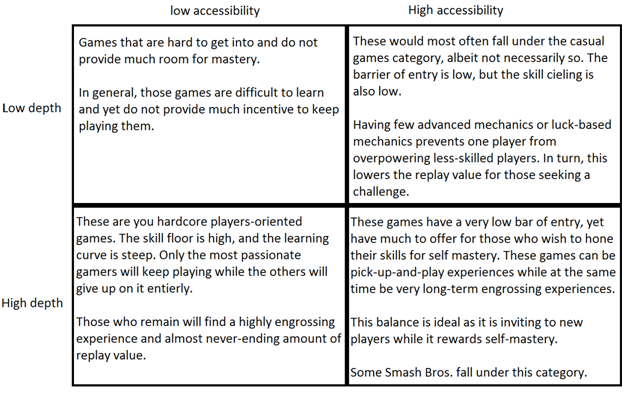
An ideal game attempts to maximize both its accessibility
and its depth. If we are arguing on the point of inclusiveness, then in stands to reason that going into the high accessibility but low depth end of the spectrum, you lose a part of your audience; the competitive audience. On the other hand, if you go on the low accessibility and high depth of the spectrum, you lose your entry level gamers. However, maximizing depth and accessibility will allow for less experienced players to enjoy the game at a surface level while allowing for self-mastery. This would be the more inclusive solution.
Argumentum ad verecundiam (argument or appeal to
authority):
“This fallacy occurs when someone tries to demonstrate the
truth of a proposition by citing some person who agrees, even though that
person may have no expertise in the given area.”
It is the assertion that a claim is true or false or good or
bad because an authority says so. The authority in question may be a person, a
book, an organization or anything that may be perceived to be knowledgeable
about a certain topic at hand. In this case, the authorities most often cited
are Nintendo and Masahiro Sakurai whom were responsible for making the series.
Some using the appeal to authority fallacy might be tempted to say that
Nintendo is an authority on game design and if they say that games should be
designed in a certain manner, then it stands to reason that this is the way
to go. However, this fails to take many things into consideration. It fails to
take into account the less successful ventures that the company has taken and it
fails to take into account the entity’s possibility of committing a mistake
despite ample evidence of it happening before. It also fails to consider that
other authority figures who have just as much experience in that field
disagree. One could ask Yoshinori Ono or Daisuke Ishiwatari's oppinions on the best way to
balance a fighting game, and they might completely disagree with how Masahiro
Sakurai operates. Finally, it fails to take into account that the relationship
between the video game company and the consumer is one of seller and client and
that most of the dialogue will be tainted by corporate marketing tactics, which
is not completely honest.
Appeal to authority can be somewhat valid in say... a
scientific argument. One could say that the statements of Carl Rogers on
humanistic psychology are more likely to be valid than those of a random talk
show host. However, in the case of designing video games, while authority
figures can comment on various technical aspects of game creation such as
modelling, animations and coding, the fact remains that video games are an
interactive experience and that controlling for each individual’s experience
with a game is impossible. Each and every person will bring part of themselves
into the game. Their interpretation of the story, their appreciation of various
mechanics and how they approach and decide to pay attention to different
aspects of the game makes playing a video game into a very personal experience.
In other words, when it comes to video games, there is no “quality”, there is
only “individual perceived quality”.
As such, one ought to want to maximize perceived quality for as
many parties as possible. In the case of Super Smash Bros., competitive players
argue that giving competitive players the tools they need to have a good time
is a good solution in this direction as it would allow the game to be playable
at both a competitive and party level. Those who argue that competitive play should
be removed from the series as a whole are aiming to lower the aggregated
perceived quality of the franchise.
The “Nostalgia goggles” argument:
This is a very frequent thing I’ve been seeing these days.
It is not a secret to anybody that I do not enjoy The Legend of Zelda Skyward
Sword. I find that I have been much too generous with my already scathing review of this game in
retrospect. Nevertheless, while I was discussing this game and how I felt that
I much preferred the control scheme and exploration aspect of the older games,
I kept being told “You just have nostalgia goggles”.


I had valid arguments. Those who do not like using motion
controllers would naturally prefer the older games. Left-handed players are also at a disadvantage. Furthermore it is a fact
that the older games in the series placed more emphasis on exploration and towns and locales. My opinion
was based on very logical reasoning and nostalgia had nothing to do with it. I
noticed later on that this argument was being used very liberally with Super
Smash Bros. “You just prefer Melee because of nostalgia”. It really struck me
how non-conducive to a healthy debate that is.
Painting someone as being nostalgic is an effective way to
attempt to discredit their opinion. They paint them as biased and thus
everything they say is wrong. However, many things must be taken into account.
Being nostalgic does not make your arguments wrong.
By definition, nostalgia is sentimentality for the past,
typically for a period or place with happy personal associations. In other
words, you are feeling nostalgia toward a game because it had a profound
positive impact on you. Arguably, a good reason for a game to have such an effect
on you could simply be that it was a very good game. It may be that this older
game did certain things better than the newer game. I see many people argue that
the latest smash that came out is the best because it’s new. Smash games have
changed very drastically over time and went in all kinds of directions. The
reality is that there are people who don’t actually care all that much about
how the game plays; they just want the new game. Whatever is newest will be best to them, regardless of inherent gameplay quality. We call this recency bias. The nostalgia goggles argument
they use is invalid and toxic to any argument.
Argumentum ad antiquitatem (the argument to
antiquity or tradition):
This is the familiar argument that some policy, behavior, or
practice is right or acceptable because "it's always been done that
way."
Some non-competitive smashers appear to believe that because
Super Smash Bros. Was initially played as a party game and that competitive
Smash came after, competitive players have no right to request a more
competitive-friendly experience. For example, many will repeat “You should play
Smash the way it was meant to be played”. However, such thinking does not take
into account that a game’s metagame evolves over time and that tradition is not
a justification for not growing with the times. It also doesn’t consider that
the author’s intent is irrelevant. Games being interactive by nature makes each
person’s interpretation and experience with the game different. An author loses
interpretative ownership of his work once it leaves his hands. Furthermore, the
fact that games are products meant for consumption first and foremost implies
that consumers are and should be free to make demands of whoever is creating
these products.
Argumentum ad hominem (argument directed at the
person)
This is by far the most prevalent argument used by a large subset of
non-competitive smashers. “This is the error of attacking the character
or motives of a person who has stated an idea, rather than the idea itself.”
For example, the person may attempt to put the competitive smasher in a
stereotypical box. “Elitist” is a word that gets thrown around a lot. While
competitive smashers know that this stereotype is a fabrication, even if it
were in fact the truth, it would not remove any validity from their argument
whatsoever.
Ad hominems are easily destroyed as the point of a debate is to
determine the validity of an argument, not the quality of the other party’s
character.
Argumentum ad ignorantiam (argument to ignorance)
“This is the
fallacy of assuming something is true simply because it hasn't been proven
false.” This argument is sometimes used
to argue that we cannot prove that advanced techniques will not deter from the
casual player’s enjoyment of the series, therefore, it would. However, this by
itself is not a valid point. In a court situation where everything is dependent
on the burden of proof, a prosecutor could never be taken seriously if he
stated “The defendant has no alibi, therefore, he is the culprit”. The
inability to prove a point does not in fact prove the contrary to be right.
Furthermore, the
competitive community has evidence of a competitive friendly game that was
enjoyed by the casual market in the name of Super Smash Bros. Melee. This was the best-selling game on the Gamecube and enjoyed by all kinds of people before a competitive scene even existed for it. It also
has further evidence with many party smasher testimonies stating that they enjoy Project
M. In light of these arguments, the burden of proof shifts to the other side.
Argumentum ad nauseam (argument to the point of
disgust; i.e., by repetition)
“This is the fallacy of trying to prove something by saying it again and again.”
Often, you will argue with a less open-minded non-competitive smasher and drive him into a corner where he will not have any more arguments. At this juncture, he will repeat the same thing over and over again. “Project M is not a real game!”. “Smash is meant to be played casually!”. These arguments are repeated over and over again like some sort of cultist chant, as if repeating them will alter the paper thin nature of the argument. No matter how many times you repeat an argument, it will not become more or less true than it was when it was initially presented.
Nevertheless, this fallacy is very popular as the more you repeat an argument; the more likely third parties are to remember it. For example, many actually still believe that competitive smash players only play on Final destination and only use Fox. That came from an inaccurate meme by Kirbopher on Newgrounds (who was not very tolerant of competitive players to begin with, and had no experience going to tournaments whatsoever at the time) that stated: “Fox only, no items, Final Destination”. And so, many wrongly believe that Super Smash Bros. 4’s For Glory mode is actually something the competitive community actually wanted. This misconception was made popular through repetition. However, repetition alone is not a substitute for a valid argument.
Any person who had even a minimal working knowledge of how competitive Smash works would know that a wide variety of stages are used and that much of the cast is represented in tournament play. They would also know that many do not favour Final Destination as it provides an edge to characters with high ground mobility and long-range projectiles.
If you want an example of this fallacy being used in popular culture, Mr. Mackey in South Park provides an excellent example. Observe how he keeps stating “Drug are bad, mkay?” Now, his point may be correct, and I will leave you to be the judge of that, but all he does is repeat the same assertion over and over again without providing any evidence. If you want your argument to stick, you need to elaborate.
Argumentum ad numerum (argument or appeal to
numbers)
“This fallacy is the attempt to prove something by showing
how many people think that it's true.” In the party smash community, it seems
to be a common thing to state that because the majority of smashers are party
smashers, their way to play is the only way to play, ergo, competitive players
have no right to complain because they are playing the game wrong, and because
many agree with them, they are right. However, no matter how many people
believe something, it doesn’t necessarily make it true.
Most individuals still believe that bullying has no bearing
on the mental development of a growing child despite mountains of research stating
the opposite. Tons of individuals still don’t believe in evolution despite ample
evidence of it existing in scientific literature. A majority of people can very
much be wrong. This is also similar to argumentum ad populum that basically
states that an argument is valid because it is popular. More... fanatical fans
of Nintendo who use this argument ought to be careful, because if majority
opinions are to be believed, the Wii U they love is a bad system.
Complex question:
“A complex question is a question that implicitly assumes
something to be true by its construction”. An example I once heard went like
this “Do you enjoy disrespecting all of Sakurai’s work?” This question assumes
something that was never said to be true. It assumes that I disrespected his work,
all of it to add to that.
This tactic is often used to shift the discussion into an ad
hominem attack, or to attempt to discredit the other party. In a court
situation for example, a prosecutor could say “Did you stop beating your wife?”
It assumes the accused beat his wife in the first place.
Cum hoc ergo propter hoc (with this, therefore
because of this):
“This is the familiar fallacy of mistaking correlation for
causation -- i.e., thinking that because two things occur simultaneously, one
must be a cause of the other.” Many have argued that Project M’s arrival killed
Brawl’s competitive fanbase. This assumption is being made because the
popularity of Project M is inversely proportional with the popularity of Brawl.
Project M is becoming more and more mainstream whereas Brawl’s scene is dying
out. Some take heavy offense to it, blaming Project M for the impending death
of their favoured Smash game.
However, the problem is that two things may happen together
by mere happenstance. One could argue that Project M keeps releasing more and
more content and interest in it is growing. Furthermore, the media has begun
covering it more and more, and that means that more people are aware of its
existence. Finally, Playing Project M does not block you from paying other games
in the series.
It may be that Brawl merely did not have the strength to
stand on its own legs as its own competitive esport. Perhaps the real reason
some players moved on to Melee and Project M is because Brawl failed to keep
them captivated and they looked elsewhere for entertainment. You may believe
that Factor A (Project M) caused the descent of Factor B (Brawl). However, it
may be that Factor B caused the rise in Factor A. Genuine disinterest in Brawl
may have paved the way for more Brawl smashers discovering Project M. It may
even be that an unrelated factor caused this to occur. Correlation does not
imply causation.
While I have heard it from competitive Brawl players, it is interesting to note that the majority of individuals who have given me this argument are party smashers who are not part of the Brawl tournament scene.
Dicto simpliciter (spoken simply, i.e., sweeping
generalization):
This is the fallacy of making a sweeping statement and
expecting it to be true of every specific case -- in other words, stereotyping.
In the smash community, we unfortunately have to walk on egg shells. There will
always come a time where one representative of the competitive community will
have enough of the verbal abuse and lash out. When this happens, people will
jump on that person’s statement and use it as an example of why all competitive
smashers are elitist jerks.
However, one person can hardly represent an entire community. It is important that whoever makes sweeping generalization be called out on it. One elitist does not make an entire community elitist.
Red herring:
“Introducing irrelevant facts or arguments to distract from
the question at hand.” Let’s say that I argue that a game should be fun for everyone,
competitive and non-competitive alike. Someone may respond “But this is not
Sakurai’s vision”. This is irrelevant to the discussion at hand.
This person is not discussing the matter at hand, which is
whether it is appropriate or not to have a game that is fun for both part and
competitive smashers. Instead, he shifts the topic about the how to reach a
compromise in the smash community to what he believes are the wishes of the
creator of the series.
Slippery slope:
“A slippery slope argument is not always a fallacy. A
slippery slope fallacy is an argument that says adopting one policy or taking
one action will lead to a series of other policies or actions also being taken,
without showing a causal connection between the advocated policy and the
consequent policies.”
A common argument I hear is that if Smash games have
advanced mechanics, then people will stop buying them and the series will die.
However, there is absolutely no evidence that this would in fact occur. If
anything, Melee sold very well taking into account the system’s lack of
popularity. The attach rate for this game is extremely high. Project M is being
played casually in many homes.
Yet again, the opposite has been seen where depth was removed
from a game and it started performing worse as a result. Final Fantasy XIII was
critically detested by most for removing player choice despite its inherent
simplicity.
There is ample evidence that this argument is fallacious.
Straw man:
This is the fallacy of refuting a
caricatured or extreme version of somebody's argument, rather than the actual
argument they've made. Often this fallacy involves putting words into
somebody's mouth by saying they've made arguments they haven't actually made.
For instances:
Debater 1: I feel that smash games should be competitively
viable. Wavedashing was great, it added so many options. I wish they brought
back Melee’s advanced techniques.
Debater 2: You are so entitled. You just want Nintendo to
make a game just for you. Filthy elitist.
The one who responded to the initial statement could not take
down the argument of debater 1 as it was, so he turned it into such an exaggeration
that it became possible to knock it down. Debater 1 did not imply in any way that he wants
to prevent party smashers from having any content directed at them, far from it.
All he wishes is to have a fast-paced game that rewards offense and had
advanced techniques from the older games in the series. He is not asking for
items to be taken out. He is not asking for all stages to be neutral. He is not
asking for a game that is made with just himself in mind. He is expressing an opinion
and a valid concern.
Conclusion:
I am one who firmly believes in having options for everyone. Gamers need to learn to excercise tolerance to the taste of others, but they also need to shy away from fanatical behaviour toward an entertainment company. Video game corporations love you as far as they can reach into your wallet, and as consumers, I think we are shooting ourselves in the foot by blindly giving ourselves up to them. Critical thinking is a great tool and it should be used to further our own consumer interests.
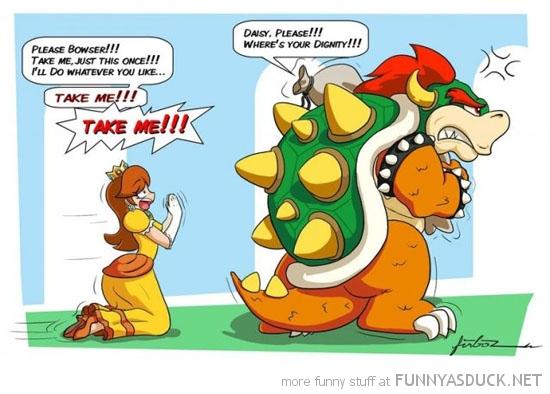
Also, let's not be like this guy:

Conclusion:
I am one who firmly believes in having options for everyone. Gamers need to learn to excercise tolerance to the taste of others, but they also need to shy away from fanatical behaviour toward an entertainment company. Video game corporations love you as far as they can reach into your wallet, and as consumers, I think we are shooting ourselves in the foot by blindly giving ourselves up to them. Critical thinking is a great tool and it should be used to further our own consumer interests.
Also, let's not be like this guy:

Credits to MegaMissigno for showing me that image.
vendredi 30 mai 2014
Princess Daisy’s 25th anniversary
Today, I felt like doing something none of the bigger
websites would ever consider writing about... or even know about. I am doing this because I felt like it would be interesting to delve into the history of one of Nintendo's more obscure characters. 2014 marks
the 25th anniversary of Princess Daisy, whom most know as the tomboy
princess from Sarasaland.

Those who know me are
aware that I have been using Princess Daisy as my go-to character in Mario Kart, Mario Party, Mario Tennis, and other multiplayer Mario experiences that
feature her. It started off as her being my “troll character” following her
infamous “Hi! I’m Daisy!” quote from Mario Kart Double Dash. I would indeed
pick her on the character select screen and proclaim “Hi! I’m Daisy!” very
loudly in order to annoy my friends. At times, I would randomly shout it while
I was racing past them in Mario Kart. Me picking her was initially a joke, but
I eventually grew fond of her as a character, likely as a result of her
becoming my go-to character.
Origins:
Princess Daisy was created by Shigueru Miyamoto’s mentor,
Gunpei Yokoi, creator of such important pieces of history as the Game Boy and
Game & Watch. He acted as the manager of Nintendo R&D until he departed
from the company. He is also the creator of Metroid and all of its initial
characters, Kid Icarus and all of tis initial characters, and Wario and the
Wario land series. More closely related to the topic at hand, Princess Daisy
was created in the context of the Game Boy title “Super Mario Land”.
In this 1989 title, the plot resolved around an alien
invasion of her desert kingdom. The tyrannical alien Tatanga kidnapped her in
order to go through his plan of forcefully marrying her and gain control over
her land. The player controlled Mario and traversed a variety of levels in
order to free her from the alien despot. Little is known about how she came to
be as a character and why Daisy was specifically designed the way she was.
Little is also publicly known about her kingdom, its denizens, and her history.
With her creator dead, much of this information may well be beyond our reach.
Her first game has also spawned a comic book series, where
she was featured prominently as an uncooperative damsel in distress. She tried
to help Mario in her own restricted way and struck at Tatanga’s ego at times.
The comic is a well-known “so bad it is good” sort of thing. It featured a real
world human villain that was at times evil beyond redemption, and at other
times, portrayed as a victim of circumstances. He set the enemies of Super
Mario Land free from his Gameboy as they wreaked havoc on the real world of the
early nineties and stylish mullet hairdos. A smurf-sized Mario set out to
defeat Tatanga with the help of over-eager teenagers. The twist: In real life,
you only die once.
In the 1993 live action film, she was portrayed by Samantha
Mathis as an archeology student who captures the heart of Luigi. The movie
again is a “so bad it’s good” and bears absolutely no weight on the canon of
the Mario universe. However, it is interesting that a non-canonical piece of
media has paired Luigi and Daisy together before Nintendo had even canonically
hinted at the idea... or did they...?
Following appearances:
Princess Daisy next appeared in NES Open Golf Tournament,
where she has acted as Luigi’s caddy, as opposed to her cousin, Princess Peach
who was Mario’s caddy. This may have been the earliest possible hint of a
relationship blossoming between Luigi and the fiery-tempered princess. However,
with this being released two years after Super Mario land (1989) in 1991 where
she was rescued by Mario and not Luigi, no one had any reasons to suspect a
future relationship with the awkward but beloved plumber. Her appearance
alongside Mario in Super Mario land 2: 6 Golden Coins has also served as a
counter-argument for that theory.
She was put aside for a long time until she was brought back
in Mario Tennis on the Nintendo 64 in the year 2000 by Camelot Software
Planning, the studio responsible for many Mario Sports games and the amazing
Golden Sun series. This was also the first time that she was ever playable.
Following this game, Daisy became a mainstay in more Mario-themed sports,
racing, and party titles, with a few exceptions such as Mario Party Advance, or
Mario Tennis on the Game Boy colour where while she is not playable, she
appears and a non-playable character.
Redesigns:
The desert princess has had several redesigns, both in terms
of appearance and personality:
Super Mario Land:
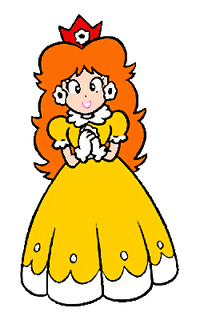
She has an appearance much more similar to Peach, but you
can already see the floral patterns on her dress and ornaments. She served the role of the damsel in distress and much like her other princess counterpart, and was a bit of a blank slate. Little was known about her personality.
It is assumed that there are feelings between Daisy and Mario. However, future titles don't seem to refer to an actual romance between them and it seems that he is more of a good friend to her. Perhaps they have had a relationship that ended, or perhaps there was never anything more than friendship, Perhaps there was a relationship that was removed from canon in future games. It may be that there is no clear continuity in Mario games. Pauline is also often forgotten for example. Most likely, her potential relationship with Luigi was added in in order to give Luigi a potential female doubles partner in sports games to mirror the Mario and Peach team (male balanced, female technical). Again, this is merely conjecture.
The comic book series and the live action movie both has interpretations of her personality, but none of them were considered canon.
Mario Tennis:

She wears a shorter dress and lacks her gloves, which makes
sense considering she is playing tennis. Most noticeable however is her skin
tone. She has darker skin than Peach, showing her origins as someone who lives
within a warmer climate; a desert nation. Of notice is that she also has
minimal makeup compared to Peach. This was the game that began portraying her
as a tomboy, which could very well explain that difference.
In this game, she was portrayed as being very close friends with Princess Peach, but her as for her potential relationship with Luigi, nothing had been really hinted at yet. She was a bit more demure as her current portrayal
Finally, she is a technical character in Mario Tennis, a trait that seems to follow her into most sports games. In Mario Tennis 64, she is the best net-player in the game.
Mario Party 3:

Mario Party 3 was her second appearance, and a particularly meaningful one. First, it had depicted her in her normal royal attire, being the first time she has worn her full dress in a game since the Game Boy days. Her crown was noticeably lighter, and the jewel on it was also a different shade. She was otherwise fairly unchanged from her her Mario Tennis depiction.
Furthermore, she was shown to have some charm and feminine traits, but also shown to be a very strong and temperamental person; even capable of just slapping Bowser away with relative ease. This has pushed her further into a more tomboyish as opposed to Princess Peach's more "proper" decorum. She also seems aware of her charms and is willing to use them to achieve her personal means.
Super Smash Bros. Melee (Trophy):
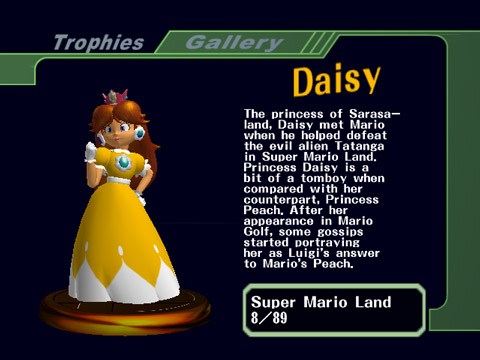
Super Smash Bros. Melee marked the earliest depiction of her on that generation of the system. She was very similar to her previous appearances down to the tiniest details. However, it would not be long until future Gamecube games would redesign her completely into the design that is currently used in 2014. We will cover these physical changes a bit later.
The Gamecube era has also solidified the possibility of a relationship between Daisy and Luigi. The picture above comes from Super Smash. Bros. Melee (2001), and the description clearly hints at a possible relationship. Mario Party 4's (2002) official manual also states that Luigi has a crush on Daisy, at the very least supporting that Luigi has an interest in her. Mario Power Tennis which came later in 2004 also has Luigi holding to her trophy for her in her ending, but then again, Both and Mario and Luigi are clearly seen to be attracted to Peach when she blows them a kiss in her ending. Some believe that Luigi and Daisy might be a complicated relationship. This is not helped by the idea that Luigi is often seen running to save Princess Peach, or even ask Mario to talk about his contributions to Rosalina in Super Mario Galaxy, also sharing an ending credits screen with her; albeit, it may also be that he simply wants some recognition. Then again, it may be that different companies working on Mario titles treat this relationship differently.
Mario Party 8:

The Gamecube era had changed her drastically with games following Super Smash Bros. Melee. Her dress was more homogenized to look like Peach's. She lost the floral white rims at the bottom of her dress, and she instead had two sets of orange rims. However, the dress shape itself was much more similar to Peach's overall, including the shape of the orange portion at her hip level. The jewel on her chest was changed from a more blueish hue to an aqua green, making it the same colour as her earrings and the gem on her crown. He crown also became golden as opposed to red or pink. He face was slightly rounded more, and her hair was cut much shorter. Most importantly, she has lost her tan. While her complexion is slightly darker than Peach's, she has a very Caucasian skin tone. While the hair and colour of her clothes was a big differentiating factor from Peach, the rest of the changes made her look more similar to Peach in other respects. The skin tone, the changes to her dress and her crown undermine the efforts they have taken to make her look more different. The Wii games, and Mario Kart 8 for the Wii U have kept this design so far and it seems to have stuck.
Her tomboyish personality has also been greatly solidified in the Gamecube era past the Super Smash Bros. Melee breaking point and it has continued from the Wii onward, which shows in the way she demonstrates her frustration whenever she loses, and the development of an increasingly sassy personality. This has been reflected in her use of a Dixie accent, valley girl speech or even ebonics at times.
Her good rapport with Peach seems to have continued throughout the series. In Mario Kart 8 for instances, one can spot a "Peach and Daisy's" storefront in one of the many courses. Mario also seems to have a continued positive relationship with her throughout the series, albeit it may be worth mentioning that Mario and her share no chemistry in Mario Superstar Baseball and its sequel. Perhaps this means that they are good friends but don't share enough chemistry to be lovers? Her relationship with Luigi seems even more evident with Daisy's Circuit in Mario Kart Wii, which clearly had conspicuously large statues of Daisy and Luigi as well as Baby Daisy and Baby Luigi dancing together. Since this is Daisy's domain, this is good evidence to assume that Luigi's feelings might be returned.
Conclusion:
I'm happy I could give some attention to a more obscure Nintendo character. I am personally more inclined to like her earlier aesthetic designs, but I do appreciate that she has more spunk than Peach. They clearly have different temperaments, and I do like the idea of Luigi having a princess of his own. However, she has not mostly appeared in multiplayer games and she has not had a chance to grow much as a character. Some look at Daisy and consider her to be a blank slate, and while I disagree, I cannot fault anyone from thinking of her that way.
Much of her is a mystery. Sarasaland has not been explored again since Super Mario Land, and she has yet to appear in a game with even minimal amounts of canonical narrative since her Game Boy days. Her lack of relevance to the main series is only slightly overshadowed by Waluigi's. In all of the years she has existed as a character, even a newly-introduced Rosalina has received more narrative attention and been given a spot in the latest Super Smash Bros. roster.
I do not believe that the issue is with the character herself, but rather that she has never had a chance to grow into a full-fledged character yet. It could be interesting to see Daisy and her kingdom appear in games involving Luigi. Perhaps a future entry in the Luigi's Mansion series, or a new Luigi-based platformer. One could says that she is a young lady I'd like to get to know better.
I would be remiss to not mention my most influential sources of information:
http://www.mariowiki.com/Princess_Daisy
http://mario.wikia.com/wiki/Princess_Daisy
mercredi 28 mai 2014
Hyrule Warriors: The angry backlash
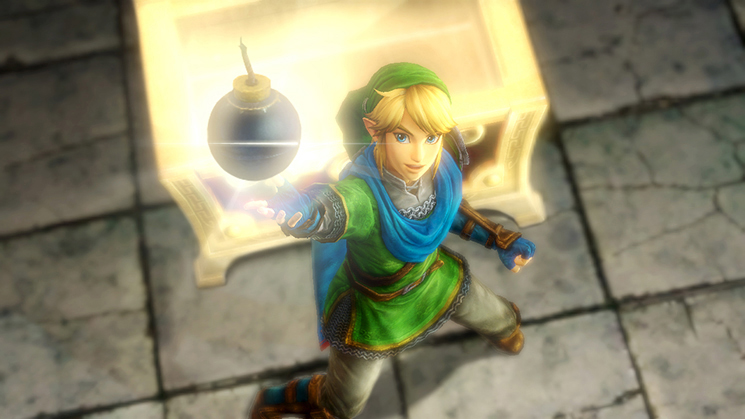
You can find items in chests like other Zelda titles.
Hyrule Warriors has caught my interest when it was initially
announced. I have always been a big fan of the Legend of Zelda series and I
have discovered the Samurai Warriors series fairly recently, which is pretty
well-made as a blend of strategy and 3D beat them up gameplay. The idea of
mixing Zelda and the Warriors series together has really made me curious, as we
would basically get an action-based strategy Zelda game.
The response to this collaboration has been very mixed,
ranging from excitement to flat out anger. Indeed, it appears that some fans
have instantly grown to hate this game; some admitting to never having even
played a warriors game in their entire life but hating it nonetheless. As a
very curious individual, I have wondered “why?”.
First case and point: The existence of Hyrule Warriors does
not prevent Zelda fans from getting the experience they want. Nintendo has
stated that this was not a main entry in the Zelda series. The flagship Zelda
for the Wii U is well under development and will be revealed at E3. Hyrule
Warriors is being made by Techmo Koei, and while Mr. Eiji Aonuma is in the role
of a supervisor, that mostly means that he is taking a fairly passive role, and
that he is mostly there to look at how the game has progressed while making sure
that it follows certain standards. He is neither a producer, nor a director.
Techmo Koei is doing most of the heavy-lifting. It is very unlikely that Hyrule
Warriors has contributed in slowing down the release of Zelda Wii U.

Impa, playable for the first time.
Second point: Hyrule Warriors can only “help” Nintendo in
their current software drought. There is very little room for misinterpretation
of the facts here: Hyrule Warriors is an exclusive Warriors game for the Wii U
with a heavy Zelda flair and influence. If anything, Wii U owners should
logically be happy about this. All this means is that they are getting an
exclusive Zelda-themed side game on top of getting an official Zelda title in
the future. While a strategy beat them up Zelda may not necessarily be for
everyone, it still adds to the software library, which is a positive.
Third point: In days where third parties have given up on
attempting to crack the Nintendo home console market, Techmo Koei is making a
conscious effort to market its games on those systems. Nintendo system owners have
been very vocal about the third party issue; calling out third party publishers
on making half-baked ports for Nintendo system, or giving Nintendo timed
exclusives only to release a better version of the game on another system a
month later. The distrust Nintendo consumers have of third parties is quite
understandable, and that frustration must no doubt contribute to their terrible
sales. When one thinks of Warner Bros. removing its Wii U DLC season pass for
their latest Batman game, forcing Nintendo to reimburse every single person who
bought it in the eshop, distrust runs rampant. However, when a company makes an
honest effort to provide a quality exclusive experience to Nintendo consumers,
it may be in our best interest to keep an open mind. After all, if Hyrule
Warriors succeeds and Nintendo gamers become interested in exploring other
entries in the Warriors series, this could very well secure Techmo Koei as a
long-term partner, add a bit of third party support for the platform.

Wizro, a vilain working for Shea. This sounds a lot like Wizrobe. He also looks a lot like a Poe. Perhaps Koei drew inspiration from these?
No one is advocating buying a game that does not spark your
interest. However, third parties will never support Nintendo systems if all we
do on Nintendo consoles is buy Nintendo games. It would most likely be to the
advantage of Nintendo console owners to sometimes explore games from other
companies; perhaps an Atlus RPG, or something made by PlatinumGames. Companies
go where the money is. If they can make a decent buck out of Nintendo systems,
they will develop for them.
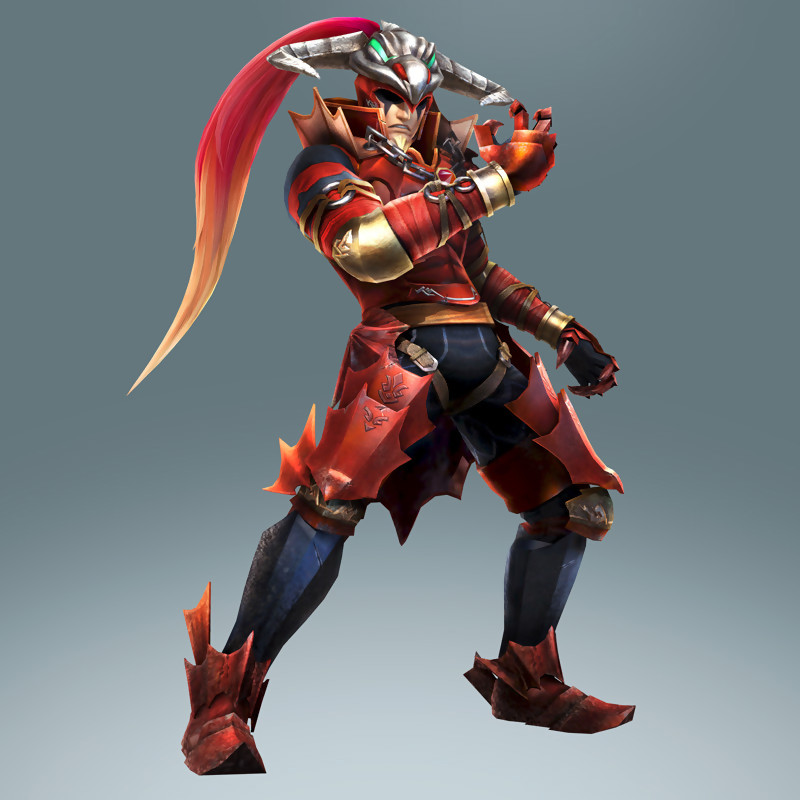
Valga, an honourable vilain. Looks strangely like a human Volvagia. Heck, even the name is similar.
In conclusion, there does not seem to be any reason to take
offense of Hyrule Warriors that is grounded in logic. I for one am excited for
it. Techmo Koei has brought in team Ninja in order to make more compelling one
on one combat action against boss characters, while Koei will be focusing on
the large-scale combat aspect. It will also utilize a Zelda lock-on system,
dodging mechanics, various weapon choices, items, heart collecting, and more.
It seems to be a Warriors game that also wants to have that special iconic
Zelda touch. Knowing this, it seems clear that it will play sufficiently
differently from Dynasty or Samurai Warriors and develop its own identity.
Getting several of their teams on board also demonstrates that they are taking
this game seriously. This may not be a main series Zelda title, but it seems to
have much promise at being a new, unique experience.
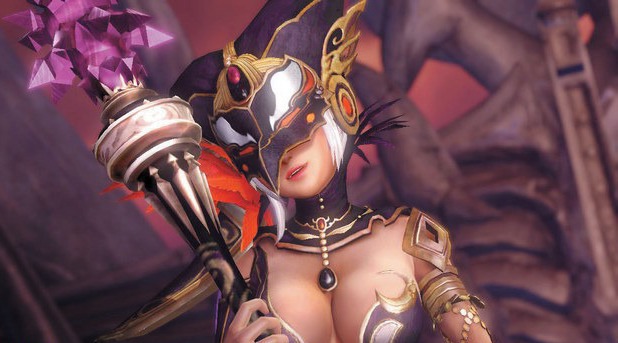
I know they were talking about Link finding chests but... yeah... By the way, this is the witch Shea, main antagonist... perhaps until they reveal Ganondorf?
Hyrule Warriors is set to appear and be playable at E3 next
month. I have high hopes that a third party game will perform well on the Wii U.
With the slow release schedule, this game will be able to tide Wii U owners
over for a little while.

Inscription à :
Articles (Atom)