I am writing this because I've seen that many individuals seem to demonstrate a high degree of intolerance towards competitive smashers in particular. Mind you, I would not say that all competitive smashers are angels, as we are all different individuals, but being in that community, I notice how misinformed people are about such the whole thing.
Many argue that Smash games should not cater to an esports audience, even when it does not come at the expense of more party-minded players. I will list the various logical fallacies I have encountered while experimenting with online debates. To make this into an easier read for the reader, I will use the more polite term "party smasher" to refer to the more.... casual elitists out there. But do keep in mind that I recognize that there are party smashers who are not in fact elitist in their behaviour.
Black and white
fallacy:
The black and white fallacy is where one presents limited
choices as the only possible choices in a situation where other options may
exist. In the Super Smash Bros. community, some are concerned that if the game
is more competitive, it stands to reason that is it going to be less
accessible. Some non-competitive smashers will say "If you make the game competitive, then it can't be played by casuals". However, this does not take into account nuances.
This position assumes that depth and accessibility are two
different ends of a spectrum. If the game gets deeper, the game becomes less
accessible, or vice versa. However, those two concepts are in fact quite separate
and there are more gray areas than one might initially believe. We can divide
these in four simple categories for easier understanding, but this is just to
demonstrate the idea:
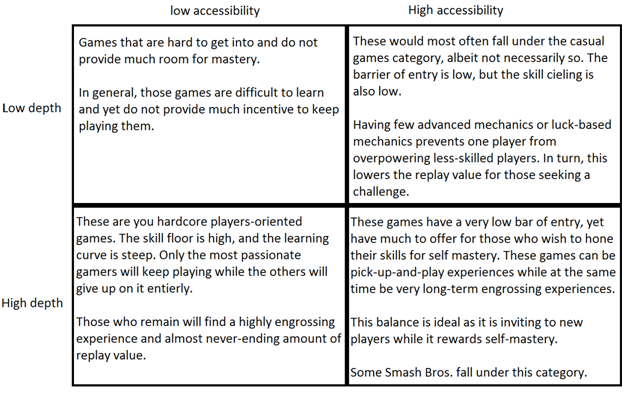
An ideal game attempts to maximize both its accessibility
and its depth. If we are arguing on the point of inclusiveness, then in stands to reason that going into the high accessibility but low depth end of the spectrum, you lose a part of your audience; the competitive audience. On the other hand, if you go on the low accessibility and high depth of the spectrum, you lose your entry level gamers. However, maximizing depth and accessibility will allow for less experienced players to enjoy the game at a surface level while allowing for self-mastery. This would be the more inclusive solution.
Argumentum ad verecundiam (argument or appeal to
authority):
“This fallacy occurs when someone tries to demonstrate the
truth of a proposition by citing some person who agrees, even though that
person may have no expertise in the given area.”
It is the assertion that a claim is true or false or good or
bad because an authority says so. The authority in question may be a person, a
book, an organization or anything that may be perceived to be knowledgeable
about a certain topic at hand. In this case, the authorities most often cited
are Nintendo and Masahiro Sakurai whom were responsible for making the series.
Some using the appeal to authority fallacy might be tempted to say that
Nintendo is an authority on game design and if they say that games should be
designed in a certain manner, then it stands to reason that this is the way
to go. However, this fails to take many things into consideration. It fails to
take into account the less successful ventures that the company has taken and it
fails to take into account the entity’s possibility of committing a mistake
despite ample evidence of it happening before. It also fails to consider that
other authority figures who have just as much experience in that field
disagree. One could ask Yoshinori Ono or Daisuke Ishiwatari's oppinions on the best way to
balance a fighting game, and they might completely disagree with how Masahiro
Sakurai operates. Finally, it fails to take into account that the relationship
between the video game company and the consumer is one of seller and client and
that most of the dialogue will be tainted by corporate marketing tactics, which
is not completely honest.
Appeal to authority can be somewhat valid in say... a
scientific argument. One could say that the statements of Carl Rogers on
humanistic psychology are more likely to be valid than those of a random talk
show host. However, in the case of designing video games, while authority
figures can comment on various technical aspects of game creation such as
modelling, animations and coding, the fact remains that video games are an
interactive experience and that controlling for each individual’s experience
with a game is impossible. Each and every person will bring part of themselves
into the game. Their interpretation of the story, their appreciation of various
mechanics and how they approach and decide to pay attention to different
aspects of the game makes playing a video game into a very personal experience.
In other words, when it comes to video games, there is no “quality”, there is
only “individual perceived quality”.
As such, one ought to want to maximize perceived quality for as
many parties as possible. In the case of Super Smash Bros., competitive players
argue that giving competitive players the tools they need to have a good time
is a good solution in this direction as it would allow the game to be playable
at both a competitive and party level. Those who argue that competitive play should
be removed from the series as a whole are aiming to lower the aggregated
perceived quality of the franchise.
The “Nostalgia goggles” argument:
This is a very frequent thing I’ve been seeing these days.
It is not a secret to anybody that I do not enjoy The Legend of Zelda Skyward
Sword. I find that I have been much too generous with my already scathing review of this game in
retrospect. Nevertheless, while I was discussing this game and how I felt that
I much preferred the control scheme and exploration aspect of the older games,
I kept being told “You just have nostalgia goggles”.


I had valid arguments. Those who do not like using motion
controllers would naturally prefer the older games. Left-handed players are also at a disadvantage. Furthermore it is a fact
that the older games in the series placed more emphasis on exploration and towns and locales. My opinion
was based on very logical reasoning and nostalgia had nothing to do with it. I
noticed later on that this argument was being used very liberally with Super
Smash Bros. “You just prefer Melee because of nostalgia”. It really struck me
how non-conducive to a healthy debate that is.
Painting someone as being nostalgic is an effective way to
attempt to discredit their opinion. They paint them as biased and thus
everything they say is wrong. However, many things must be taken into account.
Being nostalgic does not make your arguments wrong.
By definition, nostalgia is sentimentality for the past,
typically for a period or place with happy personal associations. In other
words, you are feeling nostalgia toward a game because it had a profound
positive impact on you. Arguably, a good reason for a game to have such an effect
on you could simply be that it was a very good game. It may be that this older
game did certain things better than the newer game. I see many people argue that
the latest smash that came out is the best because it’s new. Smash games have
changed very drastically over time and went in all kinds of directions. The
reality is that there are people who don’t actually care all that much about
how the game plays; they just want the new game. Whatever is newest will be best to them, regardless of inherent gameplay quality. We call this recency bias. The nostalgia goggles argument
they use is invalid and toxic to any argument.
Argumentum ad antiquitatem (the argument to
antiquity or tradition):
This is the familiar argument that some policy, behavior, or
practice is right or acceptable because "it's always been done that
way."
Some non-competitive smashers appear to believe that because
Super Smash Bros. Was initially played as a party game and that competitive
Smash came after, competitive players have no right to request a more
competitive-friendly experience. For example, many will repeat “You should play
Smash the way it was meant to be played”. However, such thinking does not take
into account that a game’s metagame evolves over time and that tradition is not
a justification for not growing with the times. It also doesn’t consider that
the author’s intent is irrelevant. Games being interactive by nature makes each
person’s interpretation and experience with the game different. An author loses
interpretative ownership of his work once it leaves his hands. Furthermore, the
fact that games are products meant for consumption first and foremost implies
that consumers are and should be free to make demands of whoever is creating
these products.
Argumentum ad hominem (argument directed at the
person)
This is by far the most prevalent argument used by a large subset of
non-competitive smashers. “This is the error of attacking the character
or motives of a person who has stated an idea, rather than the idea itself.”
For example, the person may attempt to put the competitive smasher in a
stereotypical box. “Elitist” is a word that gets thrown around a lot. While
competitive smashers know that this stereotype is a fabrication, even if it
were in fact the truth, it would not remove any validity from their argument
whatsoever.
Ad hominems are easily destroyed as the point of a debate is to
determine the validity of an argument, not the quality of the other party’s
character.
Argumentum ad ignorantiam (argument to ignorance)
“This is the
fallacy of assuming something is true simply because it hasn't been proven
false.” This argument is sometimes used
to argue that we cannot prove that advanced techniques will not deter from the
casual player’s enjoyment of the series, therefore, it would. However, this by
itself is not a valid point. In a court situation where everything is dependent
on the burden of proof, a prosecutor could never be taken seriously if he
stated “The defendant has no alibi, therefore, he is the culprit”. The
inability to prove a point does not in fact prove the contrary to be right.
Furthermore, the
competitive community has evidence of a competitive friendly game that was
enjoyed by the casual market in the name of Super Smash Bros. Melee. This was the best-selling game on the Gamecube and enjoyed by all kinds of people before a competitive scene even existed for it. It also
has further evidence with many party smasher testimonies stating that they enjoy Project
M. In light of these arguments, the burden of proof shifts to the other side.
Argumentum ad nauseam (argument to the point of
disgust; i.e., by repetition)
“This is the fallacy of trying to prove something by saying it again and again.”
Often, you will argue with a less open-minded non-competitive smasher and drive him into a corner where he will not have any more arguments. At this juncture, he will repeat the same thing over and over again. “Project M is not a real game!”. “Smash is meant to be played casually!”. These arguments are repeated over and over again like some sort of cultist chant, as if repeating them will alter the paper thin nature of the argument. No matter how many times you repeat an argument, it will not become more or less true than it was when it was initially presented.
Nevertheless, this fallacy is very popular as the more you repeat an argument; the more likely third parties are to remember it. For example, many actually still believe that competitive smash players only play on Final destination and only use Fox. That came from an inaccurate meme by Kirbopher on Newgrounds (who was not very tolerant of competitive players to begin with, and had no experience going to tournaments whatsoever at the time) that stated: “Fox only, no items, Final Destination”. And so, many wrongly believe that Super Smash Bros. 4’s For Glory mode is actually something the competitive community actually wanted. This misconception was made popular through repetition. However, repetition alone is not a substitute for a valid argument.
Any person who had even a minimal working knowledge of how competitive Smash works would know that a wide variety of stages are used and that much of the cast is represented in tournament play. They would also know that many do not favour Final Destination as it provides an edge to characters with high ground mobility and long-range projectiles.
If you want an example of this fallacy being used in popular culture, Mr. Mackey in South Park provides an excellent example. Observe how he keeps stating “Drug are bad, mkay?” Now, his point may be correct, and I will leave you to be the judge of that, but all he does is repeat the same assertion over and over again without providing any evidence. If you want your argument to stick, you need to elaborate.
Argumentum ad numerum (argument or appeal to
numbers)
“This fallacy is the attempt to prove something by showing
how many people think that it's true.” In the party smash community, it seems
to be a common thing to state that because the majority of smashers are party
smashers, their way to play is the only way to play, ergo, competitive players
have no right to complain because they are playing the game wrong, and because
many agree with them, they are right. However, no matter how many people
believe something, it doesn’t necessarily make it true.
Most individuals still believe that bullying has no bearing
on the mental development of a growing child despite mountains of research stating
the opposite. Tons of individuals still don’t believe in evolution despite ample
evidence of it existing in scientific literature. A majority of people can very
much be wrong. This is also similar to argumentum ad populum that basically
states that an argument is valid because it is popular. More... fanatical fans
of Nintendo who use this argument ought to be careful, because if majority
opinions are to be believed, the Wii U they love is a bad system.
Complex question:
“A complex question is a question that implicitly assumes
something to be true by its construction”. An example I once heard went like
this “Do you enjoy disrespecting all of Sakurai’s work?” This question assumes
something that was never said to be true. It assumes that I disrespected his work,
all of it to add to that.
This tactic is often used to shift the discussion into an ad
hominem attack, or to attempt to discredit the other party. In a court
situation for example, a prosecutor could say “Did you stop beating your wife?”
It assumes the accused beat his wife in the first place.
Cum hoc ergo propter hoc (with this, therefore
because of this):
“This is the familiar fallacy of mistaking correlation for
causation -- i.e., thinking that because two things occur simultaneously, one
must be a cause of the other.” Many have argued that Project M’s arrival killed
Brawl’s competitive fanbase. This assumption is being made because the
popularity of Project M is inversely proportional with the popularity of Brawl.
Project M is becoming more and more mainstream whereas Brawl’s scene is dying
out. Some take heavy offense to it, blaming Project M for the impending death
of their favoured Smash game.
However, the problem is that two things may happen together
by mere happenstance. One could argue that Project M keeps releasing more and
more content and interest in it is growing. Furthermore, the media has begun
covering it more and more, and that means that more people are aware of its
existence. Finally, Playing Project M does not block you from paying other games
in the series.
It may be that Brawl merely did not have the strength to
stand on its own legs as its own competitive esport. Perhaps the real reason
some players moved on to Melee and Project M is because Brawl failed to keep
them captivated and they looked elsewhere for entertainment. You may believe
that Factor A (Project M) caused the descent of Factor B (Brawl). However, it
may be that Factor B caused the rise in Factor A. Genuine disinterest in Brawl
may have paved the way for more Brawl smashers discovering Project M. It may
even be that an unrelated factor caused this to occur. Correlation does not
imply causation.
While I have heard it from competitive Brawl players, it is interesting to note that the majority of individuals who have given me this argument are party smashers who are not part of the Brawl tournament scene.
Dicto simpliciter (spoken simply, i.e., sweeping
generalization):
This is the fallacy of making a sweeping statement and
expecting it to be true of every specific case -- in other words, stereotyping.
In the smash community, we unfortunately have to walk on egg shells. There will
always come a time where one representative of the competitive community will
have enough of the verbal abuse and lash out. When this happens, people will
jump on that person’s statement and use it as an example of why all competitive
smashers are elitist jerks.
However, one person can hardly represent an entire community. It is important that whoever makes sweeping generalization be called out on it. One elitist does not make an entire community elitist.
Red herring:
“Introducing irrelevant facts or arguments to distract from
the question at hand.” Let’s say that I argue that a game should be fun for everyone,
competitive and non-competitive alike. Someone may respond “But this is not
Sakurai’s vision”. This is irrelevant to the discussion at hand.
This person is not discussing the matter at hand, which is
whether it is appropriate or not to have a game that is fun for both part and
competitive smashers. Instead, he shifts the topic about the how to reach a
compromise in the smash community to what he believes are the wishes of the
creator of the series.
Slippery slope:
“A slippery slope argument is not always a fallacy. A
slippery slope fallacy is an argument that says adopting one policy or taking
one action will lead to a series of other policies or actions also being taken,
without showing a causal connection between the advocated policy and the
consequent policies.”
A common argument I hear is that if Smash games have
advanced mechanics, then people will stop buying them and the series will die.
However, there is absolutely no evidence that this would in fact occur. If
anything, Melee sold very well taking into account the system’s lack of
popularity. The attach rate for this game is extremely high. Project M is being
played casually in many homes.
Yet again, the opposite has been seen where depth was removed
from a game and it started performing worse as a result. Final Fantasy XIII was
critically detested by most for removing player choice despite its inherent
simplicity.
There is ample evidence that this argument is fallacious.
Straw man:
This is the fallacy of refuting a
caricatured or extreme version of somebody's argument, rather than the actual
argument they've made. Often this fallacy involves putting words into
somebody's mouth by saying they've made arguments they haven't actually made.
For instances:
Debater 1: I feel that smash games should be competitively
viable. Wavedashing was great, it added so many options. I wish they brought
back Melee’s advanced techniques.
Debater 2: You are so entitled. You just want Nintendo to
make a game just for you. Filthy elitist.
The one who responded to the initial statement could not take
down the argument of debater 1 as it was, so he turned it into such an exaggeration
that it became possible to knock it down. Debater 1 did not imply in any way that he wants
to prevent party smashers from having any content directed at them, far from it.
All he wishes is to have a fast-paced game that rewards offense and had
advanced techniques from the older games in the series. He is not asking for
items to be taken out. He is not asking for all stages to be neutral. He is not
asking for a game that is made with just himself in mind. He is expressing an opinion
and a valid concern.
Conclusion:
I am one who firmly believes in having options for everyone. Gamers need to learn to excercise tolerance to the taste of others, but they also need to shy away from fanatical behaviour toward an entertainment company. Video game corporations love you as far as they can reach into your wallet, and as consumers, I think we are shooting ourselves in the foot by blindly giving ourselves up to them. Critical thinking is a great tool and it should be used to further our own consumer interests.
Also, let's not be like this guy:

Conclusion:
I am one who firmly believes in having options for everyone. Gamers need to learn to excercise tolerance to the taste of others, but they also need to shy away from fanatical behaviour toward an entertainment company. Video game corporations love you as far as they can reach into your wallet, and as consumers, I think we are shooting ourselves in the foot by blindly giving ourselves up to them. Critical thinking is a great tool and it should be used to further our own consumer interests.
Also, let's not be like this guy:

Credits to MegaMissigno for showing me that image.