mercredi 1 février 2012

Geek TV: Why Chuck went on for too long.


For those who don’t know, Chuck is pretty much a television series focused around a computer technician at a local store chain who has accidently downloaded the ultimate Intel database called the intersect, giving him knowledge of various criminal organisations and the several useful abilities such as the knowledge to diffuse a bomb. Because of that, he has to be protected by a CIA agent who pretends to be her girlfriend and an NSA agent who has a penchant for overkill. That is pretty much the initial premise. The following will be full of spoilers and may only be understood by those who have followed the series.

I originally liked Chuck. I thought that it was an interesting concept and liked most of the characters. Casey, the NSA agent was a hilariously violence-loving gun nut. Morgan was an amusing, yet compelling support character, Chuck was a realistic take on the nerdy guy who despite being smart, drifted through life because he was fairly unfortunate. Sarah, I originally disliked her and still do for she always felt relatively bland to me. This has nothing to do with the acting more so that she was solely portrayed as a tough and cold woman who actually had a hint of warmth in her heart. However, that shell already seemed rather thin from the get-go and she seemed more like a sensitive, emotionally fragile girl trying to act tough than a strong woman slowly warming up to the main character. Still, as a whole, the premise was original and the concept of the intersect was interesting. However, the show started to slowly fall apart over time when the spy element started to take a backseat.

The obsessive relationship:

A large portion of the dialogue focuses on the relationship between Chuck and Sarah as they progressively develop feelings for each other. At the beginning of the series, Chuck is uncertain about her feelings for him because she is only dating him as a cover but deep inside him, he loves her and he thinks it could be mutual. He wants it to happen but Sarah wants their relationship to remain professional.

What makes in unbearable in the end is the fact that it never stopped and even intensified throughout the later seasons. Chuck received some training as a spy and eventually stopped being confined to the van and joined Sarah and Casey on the field. However, while they were on missions, even when they sometimes had weapons pointed at them, Chuck would go on and on pestering Sarah to get an update on their relationship status. He would repeatedly lecture her about trust, ask her why he doesn’t love her, and when they finally got married; if they should quit the spy work and have a baby. Had these discussions been kept out of the missions and not been continuously repeated, it could have been acceptable and a normal reaction for a human being. However, if you’re infiltrating a terrorist base or tailing an illegal arms dealer, it is not the time to talk about such things. This makes Chuck sound like a whiny, obsessive boyfriend who is constantly in need of attention. This is not love, this is a mental disorder.

It gets worse when they are married because despite her having stated her love for him and her desire to live together with him as well as showing her love for him by disobeying direct commands and risking a court martial to save his life, he is still constantly unsure of their relationship status. She makes the reasonable demand to take things slowly so that she can adapt to this new lifestyle, but he never stops harassing her about moving things on. It’s always all about him and does not respect the wishes of his wife. Of course, she’s fine with it in the end. After the wedding, there really was nothing left to explore and they should have focused more on making compelling spy stories.

Jefster, the terrible duo:

Jeff and Lester are the idiot duo in Chuck. They work at the Buymore and throughout almost the entire series, they are oblivious of the spy business transpiring around them. They serve the same purpose as Bulk and Skull from the Mighty Morphin Power Rangers but instead of being funny in their idiocy, they are pretty much an insulting parody of the geek culture that will sometimes make you crack a laugh, but most of the time, will just make you shout “WHY!?”.

This duo made regular appearances throughout the series, but eventually took more space and started getting their own story arcs, sometimes taking almost if not half of an episode. Mild annoyance at higher frequency can turn into severe annoyance. You could compare that with bugs in a video game. Gamers will overlook small, even moderately large glitches in a video game so long as they occur infrequently. However, once a game has too many bugs, it can become frustrating, unplayable, even. Jefster is comparable to a glitch.


Casey turning into a teddy bear:


The later episodes focused heavily on Chuck and Sarah, Casey generally taking a backseat. He stopped being a badass and became grumpy smurf. He would complain that they are making things harder for themselves and ask things like if he could just shoot the villain in the face and get it over with. He would get subdued and look like a complete fool frequently. His focus seemed to have turned to his relationship with his daughter and his platonic love/hate relationship with Morgan who was dating her. This can be in large part blamed by fact that action scenes became infrequent.

Where is the action?:

This was tackled above, but what made this show enjoyable for me was the spy bits and the sci-fi elements tied to the intersect. There were mysteries to unravel, fight scenes, explosions, shootouts, intellectual gambits. The later episodes focused more on the drama aspect and I have never been a big fan of drama myself. Still, Chuck was a healthy hybrid of both and it is sad that in the end, the concept crashed.

Subway, eat fresh, stales plots:

Subway sandwiches may have some fresh ingredients, but its presence can turn a show stale. Product placement isn’t a new thing. Tons of shows arbitrarily show a bottle of coke in the background, or a car of a certain brand doing crazy tricks. The companies provide money, the show shows the product. The problem in Chuck is that is not subtle at all.

They had a character, Big Mike whose sole purpose in this show was to fill plot holes and to describe how delicious a Subway sandwich was, reciting every ingredient and making sure to mention how fresh it was. The more it went on, the more obvious the product placement was. It interrupted the flow of the show and ultimately reminded us that we were watching actors perform, not actual characters.

Yeah, it's about your heart... Do a barrel roll!:

Chuck’s sister Ellie and to a lesser extent, Captain Awesome are characters whose sole purpose is to encourage Chuck in his relationship with Sarah and to help him achieve his potential. However, they always gave the same mindless advice “follow your heart and everything will go fine”. The fact that this overused line is being used as a model for a helpful listener archetype really gets on my nerves. Sometimes, you do have to go with your intuitions because there really isn’t anything your mind can do to help you. Some problems don’t have a ready solution at hand, and sometimes, the fragments of knowledge you need to make an informed decisions are out of your reach, thus you must take a leap of faith into the unknown. However, most of the time, your emotions cloud your judgement and will make you behave in a way that will compromise the results you seek to achieve... for example, trying to solve relationship issues while disposing a bomb.

Following one’s gut reaction does not necessarily lead to a good ending and I dislike shows that always show reward following such an assertion. This is not quite realistic and I believe that it would be quite an interesting twist to see a character actually take this approach and end up disappointed, living with failure despite his best effort to step into the unknown. By constantly repeating this “follow your heart” advice repeatedly, these characters started to sound like mindless drones with only one goal in life; tell you to act like a libertarian fool.

Stand back! I’m going to try science!:

This is my personal gripe as one trained in human sciences, but I would like to make one thing clear. Brain science is hardcore stuff. I have studied the brain in specialized classes and still do not comprehend a modicum of what this wondrous structure is able to accomplish. Being a surgeon is pretty impressive and it requires incredible talents. However, a common surgeon who specializes with common ills does not have what it takes to decipher the effect on the brain that a program that even the greatest CIA and NSA specialists cannot fully comprehend. Having taken a single university class on how the brain works will not turn you into a brain researcher.

It is also evident that autobiographical memories are not things that you can lose and get back. There is a large amount of research showing that Freud theorycrafted without actually doing any research and that he was an incompetent fool... an influential, but still incompetent scientist by today’s standards. An autobiographical memory that is gone is gone forever. Procedural memory on the other hand tends to stick around. If you’re really good at a video game a tone point, you will go back to your previous skill level relatively quickly even if you spend years not practicing at all.

The accounts of patients remembering things that happened in their childhood that they had once locked inside their hearts are really just people being made to make up false memories to please the therapist. There is no intent at foolery; they don’t realize themselves that they are creating these false memories. Memories can be altered after an event like for example, make someone believe that it rained during the attack on the world trade center. Giving new information after an event causes people to add this new information, true or false to their memory, alters it. This is why members of a court jury are not allowed to see any source of media about the case they are hearing in court or why we have people claiming that they suddenly remember being sexually abuse at a month old out of the blue despite the fact that their brain has not matured enough for them to have an autobiographical memory at that age and thus cannot conceivably have this memory. Before this fact has been discovered, innocents have been jailed. Memory can be altered after the fact. New, false memories can be made and believed to be true by an individual. However, lost memory is lost forever and can never be retrieved. Being unable to remember something at a given moment is more attributable to interference in retrieval.

Nevertheless in the end, they had Morgan lose a part of his autobiographical memory by momentarily getting a hold of a glitch intersect, and then Sarah lose a large part of it through the same means, while keeping her skills and reflexes she has had in the past, which is actually logical. However, it all fell apart when they said that they could eventually reverse-engineer what caused her memory loss and put the memories back in her. Sorry Ellie, but that’s a one way. The act of downloading information to one’s mind, fine, I can get behind. However, downloading memories to me was pushing it. Honestly, had they stated that the intersect was interfering her ability to retrieve memories, I could have bought the whole thing.

This scientific formation is what makes some media less enjoyable for me at times. I heavily disliked the movie Inception because the movie was based on something that science has proven to be wrong for years. We dream in real time. That’s right; the entire premise of the movie is destroyed by one bit of knowledge alone. That’s kind of where I’m getting at with Chuck. If you’re going to use science as a means to tell a story, check your facts; ask a professional

Conclusion:

Really, I can only come to the conclusion that this series went on for too long. The series should have ended when they had figured out the intersect and Chuck and Sarah got married. The fourth season was not necessary, nor most of the third season. The story had been told and all that was left was pretty much showing the cast doing everyday things and random missions with no connection to the main plot whatsoever.

Mind you, I am not saying that this is a bad show. I thoroughly enjoyed it. The first two seasons were quite fun to me and some of the third season had interesting moments, especially with Morgan joining the team. Still, sometimes, you just got to let a series die when it’s still good.

samedi 31 décembre 2011

GHNeko's Project M PVP episode 2: Guest starring Strong Bad

Talk about Project M Donkey Kong and specific Project M stages with our Donkey Kong main Strong Bad. Watch it here.

http://fr.twitch.tv/ghneko/b/304100797


Also, there was an after stream of GHNeko, Kirisame, RyokoYaska and I chatting about various things. It's mostly random stuff.

http://fr.twitch.tv/ghneko/b/304112825

samedi 24 décembre 2011

Editorial: The Zelda Timeline interpretation

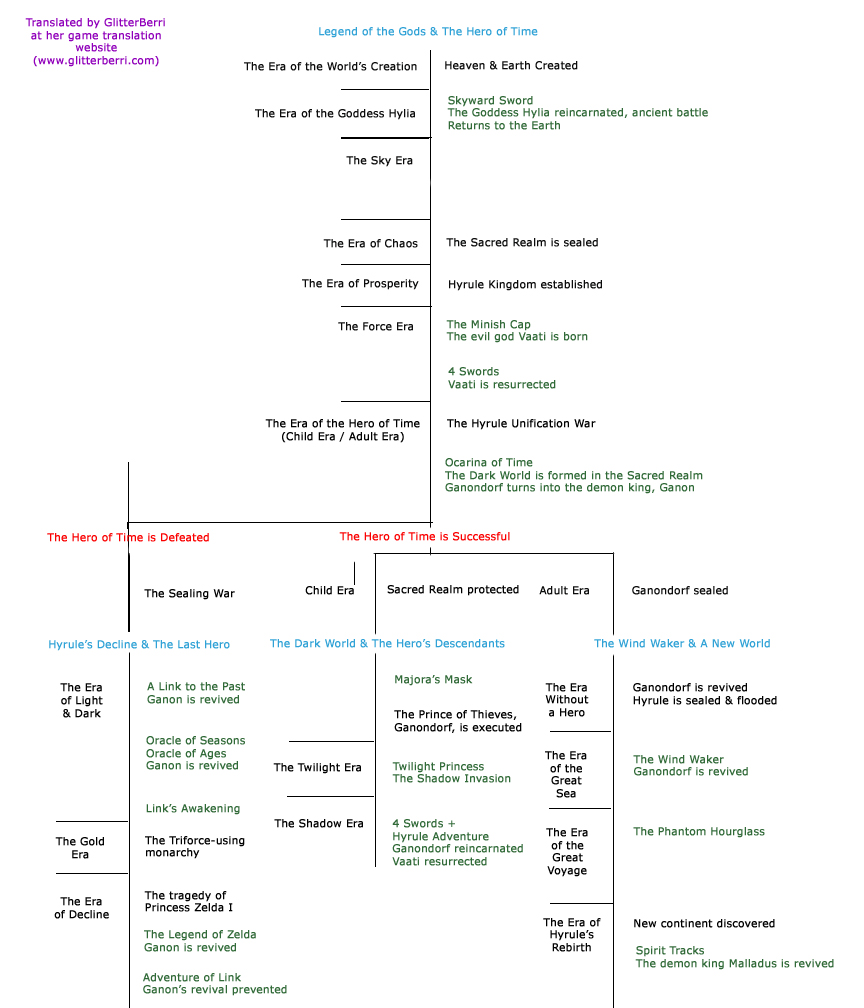
You may need to refer to this table:

Source

The most popular assumption about the Zelda series was that the timeline was split in two: One following adult Link route, the other following child Link’s cycle. It was actually a good guess, but there was an eventuality we have not pondered before, and it was if Link had lost to Ganon in Ocarina of time.


As Zelda fan, we have a difficult time swallowing the idea that Link can fail. He has always been described as the brave chosen hero who can overcome any obstacle. We also become attached to Link to the point of identifying with the silent hero. Link is you. Thus, it becomes disconcerting to imagine that Link could fall at the hands of Ganon. Since you are get so engrossed into the game, you begin to play the game as if you are Link; meaning that implying that Link failed means YOU failed. Not only does it feel “off” for the chosen hero to lose after you beat the game and saved Hyrule, but the timeline in which he failed is the timeline with the most iconic classics. The original Zelda title, The Adventure of Link, Link’s Awakening and even A Link to the Past, the most celebrated 2D Zelda game are part of this continuity.

The gap between his failure and A Link to the past was explained as a “sealing war”, meaning that individuals other than Link managed to seal Ganondorf in his place. However, one thing escapes me. Who is the next Link? From what I understand, every Link is a descendant from the first Skyward Sword Link. If Link in Ocarina of Time died, where does his descendant come from? I’m just going to assume that Link had a jolly time at Lon Lon ranch before going to meet up with Ganondorf. Of course, by defeated, “death” is not the only option. He could have lost and survived, but I highly doubt that Ganondorf would have let Link live and I highly doubt that Link would have given up. Link’s Awakening could have been placed anywhere in the timeline, being a dream.

The successful version is a puzzle of its own. On the child side, we had all come to expect that Majora’s Mask would be in this timeline, and there is some sense in Twilight princess being part of it. Let me explain. From my understanding, there are two possibilities: One explanation could be that this is not what happens after Link gets sent back in time at the end of Ocarina of time, but rather, “Sealed realm protected” could mean that child Link prevented Ganondorf to get access to the temple of time but did not fight him. Link never got the master sword and Ganondorf remained as the king of thieves. Then, the event in which he was thrown into the Twilight world in Twilight Princess end up making sense because they could not seal him without the master sword.


Another alternative is that after Link sealed Ganondorf, he went back in time and was able to use what he knew from the future to prevent Ganondorf from gaining access to the sacred realm; perhaps by warning royalty. Perhaps it was his warning that caused him to be sealed for the events of Twilight Princess. I do not know which option is more sensible.

The next timeline has Ganondorf sealed and seemingly remaining as an adult. Another possibility is that when Link is sent back into the past, he disappears from the timeline completely explaining the absence of a hero when Ganon is revived again. However, this option removes the possibility that Link has a descendant, “unless” he got lucky with Malon. I did say yes when Talon asked me if I wanted to marry his daughter on my playthrough after all.


What Nintendo is basically telling us is one of two things. One possibility is that “there is no canon route”. The storyline branches out into what-if situations based on what happened in Ocarina of time. The other interpretation that I adhere most to is that they are all canon. The events of Ocarina of Time would have caused several timelines to exist independently from one another due to Link messing with the chain of events through time. They are all happening in three alternate realities.

Take none of what I said at face value. These are hypotheses and nothing more. I believe that one of the beauties of the Zelda uni(or multi?)verse is that it allows for interpretation. Part of the storytelling is up to our imagination. If you have alternate explanations you wish to share, write them in the comments below. I would love to read them.

SPOILER ALERT for Skyward Sword:

My intepretation of the ending is really simple. Link and Zelda are the "Adam and Eve" of Hyrule. The hylians are all their descendants. As for Demise, I theorize that Ganondorf is his reincarnated form.

Merry Christmas as well by the way.

vendredi 23 décembre 2011

mardi 22 novembre 2011

Beverage reviews : Stewart’s fountain classics


When I go to work, I always need something to drink, and most of the time, I’m so tired that I require some sugar to sustain myself. At one point, I was into energy drinks, but I halted the consumption when I realized that my body was beginning to reject it. It was time to find a new, softer drug.

So I went and got myself some Stewart’s sodas during my stay in the United States (you may also find this in Quebec and Canada). It was a drink I tried a long time ago and remembered liking, but I did not have a car and since then, have forgotten the taste. I liked it so I started taking my car to by loads of them so I could bring them to work. Until now, I have tried the only four that are around my neighbourhood.

Apparently, these drinks originated from the Stewart’s restaurant chain that first started in Mansfield, Ohio in 1924 where the root beer was quite famous. This is not unlike the history of A&W as you can see. The bottling license was passed on to different companies but the quality did not decrease as drastically as one would imagine, if at all.

So let’s look at a few of the flavours from my least favourite to most favourite:


Key lime:


This one is strange. It is a creamy drink that tastes like lime. It is quite refreshing but the taste is more akin to carbonated, creamy, sweet lemonade. Actually, I could say that this most resembles Perrier with lemon Torani syrup in terms of taste (although tastes better). It has a lingering lime aftertaste. I’d say it’s a good drink but may not please everyone.

Rating:


Cream soda:


If you are used to cream soda being clear, this is a golden-coloured drink that makes you look like your carrying beer if you have a bottle of it on the streets. It’s a cream soda, not unlike Fanta, but more creamy and with a dash of vanilla. Once you drink it, the cream soda taste is immediate, then the vanilla taste takes over. Don’t go into it thinking you’ll drink regular cream soda. Vanilla is the most prominent taste and the aftertaste will also be of vanilla. It’s pretty good, but again, you got to like vanilla.

Rating:


Root Beer:


This is the most famous Stewart’s sodas and pretty deservingly so. It is a creamy again, like most Stewart’s sodas, but also doesn’t have an overbearing taste like A&W root beer. It’s soft, sweet. I think this beats A&W root beer any day. As for the after taste? Just tastes like the root beer you drank, leaving some of the creamy flavour behind.

Rating:


Orange ‘n Cream:


Believe it or not, I am not a big fan of orange soda. I drink it just fine and I don’t dislike it, but I would almost never choose it given another choice. This drink is different however. It tastes like ice cream popsicle, the kind that is orange-flavoured with vanilla inside. The creamy aspect is used particularly well here to emulate this taste, and strangely, doesn’t feel weird at all. The creamy vanilla ice cream aftertaste seems to linger on a bit longer than the orange does.

Rating:


The only problem I have with Stewart’s soda is that they are a bit more expensive than regular sodas for their rather small quantity. They taste very good and constitute a very fine treat. It is something to drink slowly and enjoy. I highly recommend them, especially if you are into creamy flavours. This is currently my favourite. When I feel like it, I will probably cover energy drinks.

lundi 21 novembre 2011

Modern gaming review : The Legend of Zelda : Skyward Sword.


1. Introduction
2. Aesthetics
3. Audio
3-1: Music
3-2: Sounds
4. Story
5. Gameplay
5-1: Controls
5-2: Difficulty
5-3: Gimmicks
5-4: Stage design
6. Conclusion

1. Introduction:

The Legend of Zelda series is one with a venerable history. It has consistently produced highly-rated and popular adventures for a very long time and always seemed like the kind of series that can never go wrong. This has been mostly true until the Nintendo DS came out and two less-than-stellar Zelda titles came out with poor controls and underwhelming gameplay despite strong artistic concepts and very fine ideas. Then, there was the case of Twilight Princess, which seemed botched and uninspired. It was a decent title, but one expects more than “decent” from a Zelda game. Playing it on the Wii however lowered the “decent” rating to a “mediocre” rating due to adding poor controls to its list of frustrations. I believe that the franchise was growing stated of late and that it needed a wind of change. Is Skyward Sword this wind of change or is it naught but a pestilent fart in our general direction?

2. Aesthetics:

I can only explain the general look of this game this way: It is a mixture of the cartoony graphics of Wind Waker and the realistic designs of Twilight Sword. The developers stated their intent at making this game look like an impressionist painting, and they do well in that regard. The characters are detailed enough to satisfy those who hated Wind Waker’s design, yet cartoonish enough to get creative with its animations. The characters are very expressive and I must say that I was quite pleased to see Link exhibit emotions without the need for any narrative to demonstrate it. Character design is fairly well done, with Link’s light green tunic being closer to his Ocarina of time design, yet sporting a discrete chain-mail not unlike Twilight princess. Zelda herself looks completely different but it is not an appearance that I find averse. She looks younger, more innocent. Yet, it fits with her character’s in-game personality and role quite well. While there are few NPCs in Skyward Sword, some look rather normal (usually more serious character) and others, completely whacky. It is a nice entertaining mix that I do not object to at all. The world is very colourful and detailed despite being merely textures. You will only notice graphical flaws if you stop and look for them. Enemy design is neither better nor worse than in other Zelda titles. However, you will notice less variety in the kinds of enemies in game. It is a very nice-looking title artistically.

3. Audio:

3-1. Music:

Several tracks in this game are orchestrated, finally. This is something everyone wanted and it really helps drive home the concept of an epic adventure. Some old classics return, but for the most part, most tracks are fresh and new. Not all songs are memorable however, but quite a few are. Overworld music tends to be rather bland and repetitive after a while, and dungeon music is pretty much your usual ambiance music from other Zelda games. The flight music is quite epic and so are the boss battle themes in general. Event tunes generally prevail at making you feel the emotions they want you to feel. It’s a good soundtrack overall. I was ready to lower its mark in the event where there would not be any orchestrated music. Since part of it is and part of it isn’t, it’s quite good but could be better.

3-2. Sound:

This game uses sound cues everywhere, and I am not kidding. You get a sound cue if your wallet is full, if you have a full bomb bag, if you have five hearts or less when drowsing for something, when your Wiimote battery is almost depleted, name it. The most noteworthy one is the inclusion of the sound-cued sword strikes from Wind Waker. They are a welcome addition. However, the sound cues can become grating at times. For instances, in this game, you lose more health when hit. So you are more likely to be at lower health. The fact that it start constantly beeping at five hearts can becoming rather annoying. Also, whenever Fi, the spirit of the Skyward Sword wants to talk to you, the sound cue will never stop until: 1) You indulge her, 2) The thing she wanted to tell you has become irrelevant. This by no means ruins your experience, but if can be a bit of a bother.

4. Story:


The Legend of Zelda Skyward Sword boast a story, and I don’t mean just a narrative separate from the dungeons; I mean an actually story where Link, Zelda and other key characters actively participate. It is a story that tells much about the history of Hyrule, and rather than being presented through a long monologue only to stop talking about it for a long time, it is paced throughout many points of progression, never feeling too heavy, yet often feeding you with more bits and pieces of the storyline. In a sense, this holds your interest for longer durations. However, it does come at a price: The game is much more linear and this is very apparent in the stage design. Mr. Aonuma and his team really didn’t want you to access certain areas until you had triggered specific scenes. You are following a straight route from the beginning to the end with little room for interpretation or plain old fooling around and discovering new things. It is by far the most interesting Zelda Story in quite a while, but now you must be wondering: I can just watch a “let’s play”, so is the gameplay any good?

5. Gameplay:

This is where Skyward Sword gets mixed results. On one hand, Skyward sword has many great concepts while on the other, it is plagued with many annoyances that render the gameplay tedious for no reason whatsoever.

5-1. Controls:

Skyward Sword used the Wii Motion Plus accessory with the promise of providing a full 1:1 motion capture experience. I will start by saying that this is quite possibly the most precise motion experience the Wii has to offer. However, this is not 1:1. The game pretty much follows your movements with a minimal but still visible amount of lag. However, if you perform an action such as slashing with your sword, the Wiimote will approximate that motion, thus Link cannot for example do a curved slash. Also, no matter what length you swing, Link will always swing at the same width.

Also, while it is not explicitly explained in game, you are supposed to hold your Wiimote tilted to the side for best results. Holding the Wiimote like one would for a shooter game like Metroid Prime 3 would generally result in Link slashing diagonally. Save yourself some pain and heed this warning. The Wiimote is also too sensitive, meaning that at times, you will attempt to reposition your sword to the other side of your body, but Link will frantically slash like a madman. This get especially frustrating when you are facing a foe with electric attributes or weapons and you constantly damage yourself due to Link no responding as he should. There are already Ocarina codes for hackers out there that allow you to edit your controller sensitivity to your liking, but it will never fully fix the problem.

As a whole, the motions are more responsive that your average Wii game but do not replace buttons in terms of precision. While the motions will often go in the general direction you tell them to, it will sometimes happen that Link will not do what you tell him to or will act against your will. Sometimes, the Wii Motion Plus will go haywire and Link will act as such.

The problem expands to the pointer, where you constantly need to push the down button on the D-pad to put your pointer back on the middle of the screen. It will happen almost every time you need to bring the pointer to the screen and gets somewhat worse if you are not pointing at the middle of the screen when you activate that map, item, or travel phase. It is fairly bothersome because you cannot expect to pull off an item and quickly use it in battle. Thus it will often result in players only using the sword in combat.

Despite the weak reliability of motions, the idea of requiring certain kinds of slashes to defeat foes is interesting, although this could be easily achieved by pressing A and using the Joystick, an input that existed in Ocarina of Time. It is regrettable that one can waggle through most enemies and decimate them. Other positive additions include the ability to temporarily dash using a stamina meter. It allows fast movements and the ability to run a few steps up walls, which creates interesting puzzles. The only problem is that the meter takes a very long time to refill and makes the ability to run a bit less interesting. Being able to roll bombs and upgrade items, shields and potions is also very interesting but I would like to see this system become more complex. Skyward Sword is full of great ideas executed poorly.


Finally, there are no left-handed controls; something even Wii Sports Resort was able to include. There is no excuse for this, and if you are not willing to put in the extra effort to accommodate the left-handed, just stick to traditional controls.

5-2. Difficulty:

The game is harder than your average Zelda, and there is a hero mode that increases the difficulty once the game is cleared. Hackers can most likely download save data if they are impatient. Enemies do more damage, taking an average of a full heart per hit. Bosses can be positively challenging as well since they are puzzles in and of themselves. However, if you die, it will probably be due to your Motion plus going crazy at an inopportune moment or Link moving against your will. You are not likely to feel that your death was due to your own mistake. I have actually died three times on a relatively easy timed-boss battle because I was wrestling with the Motion Plus losing its axis no matter what I did. After shutting down the system and opening it again, it fixed the problem for about five minutes.

Some things like not losing a heart when falling in a hole makes parts of the game extremely easy.

5-3. Gimmicks:

This game is like a very long and in-depth Wii Motion Plus tech demo. It finds every opportunity to make use of motions in every possible situation, to a point where there is so much that you You can spend a whole hour never touching a single button. Combat, flying, catching bugs, swimming, rolling, twirling, aiming, using items (most of the time), using special keys, falling, it is a Wiimote overload. What is saddening is that everything Motion Plus can do within the scopes of this game, classic controls can do better. There was no instance of using motions where I thought “hey, I couldn’t do this on a classic controller”.

Since Z-targeting does not make your ranged items lock on to targets, and aiming will most likely result in losing your middle axis, one would almost never use them in true combat. Z-targeting is only good for the sword and shield and out of combat, for the bug-catching net. The gimmick gets worse when most sidequests are minigames that make you repeat that same dull motions over and over again. Bug-catching could be less –demanding in terms of quantity since it is a rather boring aspect of the game when not done within the context of catching those you run into while advancing the plot.

The game has a tendency to force motions at every turn when another, better option could easily be available. Too many gimmicks make this reviewer frustrated, an emotion one should never feel while playing a game.

5-4. Stage design:

The stage design is both good and bad. On one hand, you have puzzles even out of the dungeons, which really will please the avid puzzle fans out there. However, this comes at a cost of having no overworld whatsoever, needing to travel back to a hud in the sky and to dive down to a level like in Super Mario 64. It could have been acceptable if there were more than just three levels for most of the duration of the game. Having to revisit these areas over and over and over again becomes a grating chore. The “grand world of Hyrule” below feels laughably minuscule. There are very few NPCs to interact with below the clouds, many “fetch and bring back like a good dog” sidequests. It’s good that you get to know some NPCs better as the story progresses however, but the world is so small and unpopulated that it still feels unnatural. The temples are creative, yet very linear. The puzzles are unlike anything you have seen in other Zeldas before, which adds a surprise element, but they are sadly very easy and if the answer is not right in front of you, take a few steps forward in the dungeon’s linearity and the answer will jump into your arms like a lost Nintendog looking to please its casual gamers.

Really, the great aspect is that you may be pleasantly surprised with more varied puzzles but I do wish they did not spell out the solution to you. Another positive aspect is that you now get to use most of your items in dungeons, so you don’t just solo a dungeon with the item you found within the temple anymore.

You will spend a lot of time doing puzzles in Skyward Sword, so if this is what you like most of a Zelda game, you will get your wish.

6. Conclusion:

My review may seem harsh to many but I have also enumerated about as many good points. The grade was brought down due to the fact that Gameplay was the worst aspect of Skyward Sword and it counts for much more than aesthetics and sound. And yes, I have seen the response Gamespot has gotten for its attempt at integrity. As I have said earlier, The Legend of Zelda’s past iterations have with a few exceptions, been ranging from very good to stellar, so this review takes this as a basis for comparison. I would like to point out though that. Whether you like it or not Skyward sword has many continuous annoyances and design flaws, and I cannot in my right mind give it a perfect grade. I am fully aware that I could get lots of hate from it and you know what? Just go ahead, give me your worst. I can already see some of you going:


Heck, I've even been called "petty" on various occasions for disliking elements from this game. You could claim that I am a Sony or Microsoft fanboy. However, I do not own any Microsoft systems and my acquisition of Sony systems is recent as a response to the Wii’s motion fad. You could say that I am biased toward hating motions, yet have played the game in its entirety and would have eventually gotten used to it. I could not have gotten paid since this review was made on an amateur blog. Yep, you got nothing on me. That fanboy mentality for every Zelda game has to stop. If you are going to get mad every time a Zelda game gets less than 9.5 out of 10 and are convinced that no Zelda can possibly be flawed enough to get less than that, then why are you reading reviews in the first place?

It’s an okay game. The story is its main selling point, but the gameplay is rather underwhelming. I would rather have watched someone play than deal with the frustrating aspects of the gameplay. Get it if you are a very dedicated Zelda fan and for some strange reason, you like motions.

Positive:

Great artistic style.
Some memorable audio.
More difficult than average Zelda title.
Original stage design
Great Story
Original puzzles

Negative:

Unresponsive controls.
Constant need to adjust Wii Motion plus
Little exploration
Linear stage design
Gimmicks overload
No left-handed support
Laughably easy puzzles

7/10

mercredi 14 septembre 2011

Editorial: Operation rainfall and the fail that is Nintendo of America


With the release of Xenoblade Chronicles, I’d like to take this opportunity to comment a little on operation rainfall. It’s an operation that has risen since Nintendo of American did not seem very inclined to localize Xenoblade Chronicles, The Last Story and Pandora’s Tower. These titles seemed to have been made with high production value and also seemed to cater to the hardcore gamers. With the Wii’s current library, a hardcore gamer does not really feel at home, and as you could imagine, we were ecstatic. Yet, Nintendo of America decided that these games were not fit for translation. Two of them are RPGs, so I expect that the company believed that they would not sell well because the North American conventional gamer has come to shun all that is too traditional or Japanese. I also expect that the company did not think that those games fit the image of its clientele. But the problem here is not only for us, but for them as a business. Their actions of Nintendo do not follow their words. Nintendo of America is known for making many bad business decisions, but really, this is not an isolated incident.


Here is a list of games Nintendo published only in Japan:

- Mother (NES)
- Super Mario Bros 2 (Japan) (NES) (Released on Virtual console)
- Nazo no Murasame-jō (NES)
- Famicom Tantei Club (NES)
- Shin Oni Ga Shima (NES)
- Time Twist: Rekishi no Katasumi de... (NES)
- Yūyūki (NES)
- Knight Move (NES)
- Backgammon (NES)
- Mahjong (NES)
- Famicom Golf: U.S. Course (NES)
- Famicom Grand Prix II: 3D Hot Rally (NES)
- Famicom Tantei Club: Kieta Kōkeisha (NES)
- Famicom Grand Prix: F1 Race (NES)
- Famicom Golf: Japan Course (NES)
- Nakayama Miho no Tokimeki High School (NES)
- Pro Wrestling - Famicom Wrestling Association (NES)
- Vs. Excitebike (NES)
- Clu Clu Land: Welcome to New Clu Clu Land (NES) (Released later in Animal Crossing)
- Panel de Pon (SNES) (Tetris Attack and Pokemon Puzzle League are based on it)
- Sutte Hakkun (SNES)
- Zoo-tto Mahjong! (SNES)
- Mario & Wario (SNES)
- Marvelous: Mouhitotsu no Takarajima (SNES) (First game involving Eiji Aonuma)
- Power Lode Runner (SNES)
- Power Soukoban (SNES)
- Mario's Super Picross (SNES) (Released clones much later)
- Heisei no Shin Onigashima (SNES)
- BS Zelda no Densetsu (Satellaview)
- BS Mario Paint: Yuu Shou Naizou Ban (Satellaview)
- Fire Emblem Akaneia Senki (Satellaview)
- Wario's Woods: Burst of Laughter Version (Satellaview)
- Yoshi no Panepon (Satellaview)
- Kirby no Omocha Hako (Satellaview)
- BS Zelda no Densetsu (2nd map) (Satellaview)
- BS F-Zero Grand Prix (Satellaview)
- Itoi Shigesato no Bass Tsuri No. 1 (Satellaview)
- Mario Excite Bike (Satellaview)
- Wario's Woods: Again (Satellaview)
- BS Zelda no Densetsu Kodai no Sekiban (Satellaview)
- BS Dr. Mario (Satellaview)
- Panel de Pon Event '98 (Satellaview)
- Marvelous: Camp Arnold (Satellaview)
- Marvelous: Time Athletic - Unknown
- Satella Q (Satellaview)
- Satella Walker (Satellaview)
- Satella Walker 2 (Satellaview)
- Shin Onigashima (Satellaview)
- Sim City: Gai Tsukuri Taikai (Satellaview)
- Special Tee Shot (Satellaview)
- Super Famicom Wars (Satellaview)
- Super Mario Collection (Satellaview)
- Super Mario USA Power Challenge (Satellaview)
- Sutte Hakkun (Satellaview)
- Sutte Hakkun '98: Winter Event (Satellaview)
- BS Tantei Club: Yuki ni Kieta Kako‎ (Satellaview)
- Zootto Mahjong! (Satellaview)
- Yakuman (GB)
- Game Boy Wars (GB)
- Picross 2 (GB)
- Kaeru no Tame ni Kane wa Naru (GB)
- X (GB)
- Koro Koro Puzzle Happy Panechu! (GBA)
- Domo-Kun no Fushigi Terebi (GBA)
- Tomato Adventure (GBA)
- Mother 3 (GBA)
- Hamtaro: Rainbow Rescue (GBA)
- Mother 1 + 2 (GBA) (Double the insult)
- Famicom Minis (GBA)
- Sennen Kazoku (GBA)
- Eyeshield 21: DevilBats DevilDays (GBA)
- Rhythm Tengoku (GBA)
- bit Generations: Boundish (GBA)
- bit Generations: Dialhex (GBA) (Remade as an Art Style)
- bit Generations: Dotstream (GBA) (Remade as an Art Style)
- bit Generations: Coloris (GBA)
- bit Generations: Orbital (GBA) (Remade as an Art Style)
- bit Generations: Soundvoyager (GBA)
- bit Generations: Digidrive (GBA)
- Densetsu no Starfy 1 (GBA)
- Densetsu no Starfy 2 (GBA)
- Densetsu no Starfy 3 (GBA)
- Magical Vacation (GBA)
- Custom Robo GX (GBA)
- F-Zero Climax (GBA)
- Sakura Momoko no Ukiuki Carnival (GBA)
- Kuruin Paradise (GBA)
- Calciobit (GBA)
- Custom Robo V2 (N64)
- Dōbutsu no Mori (N64)
- Sin and Punishment (N64) (Released on Virtual console)
- Doshin the Giant (GC)
- Dōbutsu no Mori e-Plus (GC)
- GiFTPiA (GC)
- Kururin Squash! (GC)
- Donkey Konga 2 (GC)
- Eyeshield 21: Field Saikyou no Senshi Tachi (Wii)
- Wii Chess (Wii)
- Minna no Joushiki Ryoku TV (Wii)
- Disaster: Day of Crisis (Wii)
- Another Code: R - A Journey Into Lost Memories (Wii)
- Takt of Magic (Wii)
- Minna ga Shuyaku no NHK Kouhaku Quiz Kassen (Wii)
- Ando Kensaku (Wii)
- Fatal Frame IV (Wii) (They published it in Japan)
- Captain Rainbow (Wii)
- Jam With the Band (DS)
- Daredemo Asobi Taizen (DS)
- Osu! Tatakae! Ouendan (Series) (DS) (Elite Beat Agents is different in musical content)
- Jump Super Stars (DS)
- Nintendogs: Shiba Inu and Friends (DS) (Okay, small loss)
- DS Rakuhiki Jiten (DS) (A Japanese Dictionary)
- Yakuman DS (DS)
- Kanji Sonomama: DS Rakubiki Jiten (DS)
- Magical Starsign (DS)
- Densetsu no Starfy 4 (DS)
- English Training: Have Fun Improving Your Skills! (DS)
- Project Hacker: Kakusei (DS)
- Jump Ultimate Stars (DS)
- Chōsōjū Mecha MG (DS)
- Eyeshield 21: MAX Devil Power (DS)
- Mawashite Tsunageru Touch Panic (DS)
- Kanshū Nippon Jōshikiryoku Kentei Kyōkai: Imasara Hito ni wa Kikenai Otona no Jōshikiryoku Training DS (DS)
- Mawashite Tsunageru Touch Panic (DS)
- Wi-Fi Taiyou: Yakuman DS (DS)
- Kenkou Ouen Recipe 1000: DS Kondate Zenshuu (DS)
- Point & Speak Travel Notebook (DS)
- Touch Hyakunin Isshu: DS Shigureden (DS)
- Jet Impulse (DS)
- Kuikin Nano Story Island (DS)
- Ganbaru Watashi no Kakei Diary (DS)
- Slide Adventure: Mag Kid (DS)
- Zekkyō Senshi Sakeburein (DS)
- Theta (DS)
- Facening de Hyōjō Yutaka ni Inshō Up: Otona no DS Kao Training (DS)
- Suujin Taisen (DS)
- ASH: Archaic Sealed Heat (DS)
- Kousoku Card Battle: Card Hero (DS)
- Make 10: A Journey of Numbers (DS)
- Soma Bringer (DS)
- Daigasso! Band Brothers DX (DS)
- DS Uranai Seikatsu (DS)
- Tomodachi Collection (DS)
- Okaeri! Chibi Robo! Happy Richie Dai Souji (DS)
- Nihon Keizai Shinbunsha Kanshuu: Shiranai Mamade wa Son o Suru Mono ya Okane no Shikumi DS (DS)
- Last Window: Mayonaka no Yakusoku (DS)
- Many Fire Emblems, even new ones (Various)
- The Tingle games (Various)

I found this much from the first two pages of a single Google search. Many of these games are bad or do not fit for the North American audience. One rarely plays Mah-jong here and a Wario’s Woods version of the game that features popular Japanese idols would not make sense here. However, in the case of Xenoblade, The last Story and Pandora’s Tower, we’re talking about very high budget titles that would attract part of a hardcore audience; one Nintendo has been steadily losing since the Wii was released. Games like Fire Emblem, Mother 3 or Jump Superstars obviously fits a niche audience on North American territory, but sometimes, you got to take a calculated loss.

The casual gamer will not be a majority forever in the console business. Casual gaming will continue of course, but the casual gamer cares less about quality and more about convenience. The casual gamer doesn’t care if his game lasts 80 hours, he will likely never play more than five. The casual doesn’t care if his controls are very precise, so long as it passes time. The casual is what he is called: a person who does not take video games seriously. This person does not play with any passion and because of that, he or she will not seek to be particularly informed. I believe that this kind of individual will soon migrate towards gaming on the iPhone, which will conveniently always be with them; eliminating the need to carry a second device around. It’s cheap (they already got one anyways) and it’s easy to use. In other words, I believe that companies that will not prepare for this shift will suffer dire consequences, and this may be why Nintendo is currently attempting to reassure the core gamer that he or she will have content to spare on the Wii U. If you make fun and complete games, you will generally attract some hardcores. While the hardcore is currently a minority in the gaming industry, it is a security blanket, an audience that will continue to game after the casuals outlive the fad. I may be absolutely wrong, but I’m pretty convinced that the casual gamer does not constitute a very reliable audience in terms of fanbase loyalty. In fact, according to the desertion in investors, I can safely assume that I am not the only one who thinks that way. However, the solutions brought forward by these investors are ludicrous at best.

Source

Source 2


Some of the analysts think games don’t make a difference, which may be true. In the past, it was all about the games. You bought a Nintendo system because of Mario and Zelda. You bought a Sega for Sonic and Golden Axe. Hell, you even bought the Turbo Graphix 16 for YS if you were savvy enough in obscure titles in this era where gaming magazines actually were useful and Internet was absent from our homes. Investors also seem the think that Nintendo should go the mobile phone route. Honestly, I don’t think so. There is a difference between what a mobile phone can do and what a gaming console can do. The shape required to make a phone ergonomical requires a smaller screen, and a different control set-up. Needless to say, it would be very awkward to use a 3ds or PSP to talk on the phone. Maybe you could have some Bluetooth attachment on it but then again, these gaming systems would steer away from their original goal: create a high production value entertainment experience for the consumer. There is a reason why people own both a phone and a gaming console at the same time: They provide different experiences and fulfill different needs for different kinds of consumers. If Nintendo were to get into the phone business, it might actually get crushed anyways by the more established Apple. The result would have been the same, but with more magnitude: lost of investors.

It takes a lot to lose a fanboy. I for example accepted the lack of games on the Gamecube because it had Super Smash Bros. Melee, which I played long enough to freeze the gameplay timer. I bought a DS despite most early DS games being full of bothersome gimmicks. I even bought a Wii hoping that like the DS, they’d get better at it. I even bought Super Smash Bros. Brawl and tried really hard to like it, but in the end, it was so bad to me that for the first time, I legitimately hated Nintendo and bought a PS2 and a PS3 post-haste. And even if I am frustrated that most Nintendo games are almost unplayable for a left-handed person who is not quite as ambidextrous as some, that they ruined my favourite gaming series of all time, that they use gimmicky motions everywhere while if I prefer classic controls, I still technically have a glimmer of care for this company. I spent countless days saving the Lylat system, rescuing the princess and finding the magic sword. Some of the most enjoyable moments in my existence were early mornings when I had finally finished a game, body dead-tired, eyes burning red, and feeling like throwing up. The sense of accomplishment took precedence over all of these ills. With the lack of difficulty in games these days, the sense of accomplishment is gone. At times, the game has no ordeal to challenge, nor does it have a goal, rules, or even gameplay at all. So of course, the hardcore gamer hangs on to these rare good new titles; might be a change of pace from beating Chrono Trigger for the twelfth time. The fanboyism never fully leaves. It is comparable to the love a parent retains for his delinquent child. You don’t agree with him but you still care. You know the next Final Fantasy is going to suck, but you will check it out every time hoping in vain that it will capture but a glimmer of what made the early series so great.

As I have stated earlier, last E3, Nintendo tried to reassure us that we would get out share of hardcore games. However, they are also doing nothing about the lack of hardcore games right now, which removes all of the credibility their claims could have had. When the Wii U comes out, I will be careful, and I may not buy it right away, if I do at all. I know that Super Smash Bros 4 will not beat Project M, so there is no reason to get it. With the more classic-style controller of the Wii U, perhaps we will be able to use better-suited controls for hardcore titles. However, Nintendo of America’s attitude does not bode well for us. We are left with many questions like “Will Nintendo betray my trust as a consumer once again?”, “Will they take a hardcore direction temporarily to focus on the casuals again?”or “Will it matter at all? What if the good stuff doesn’t get released here anyways?”. There is no excuse for not releasing Xenoblade. The game has already been fully translated into English, French and several other languages in Europe; there is little left to do.

All this is doing is inciting people to load pirated copies through USB and making them angry and distrustful. There are many people who genuinely don’t want to pirate their games, but make an exception just for imported games. Others just don’t want to hack or pirate at all. Thus they are left with mind-numbingly boring and easy games or are denied the ability to own a game they want. Well, there is always the solution of getting a Pal Wii and a Pal disc, but the import costs are horrendous.

Operation rainfall’s supporters are likely an amalgalm of each type of person here. They are no different from the benevolent hackers who are working on Project M’s development to repair the blunders in Super Smash Bros. Brawl, or the guy who made the Classic controller support code for Donkey Kong Country Returns. They want something and they are trying to do something about it. As a fellow gamer, I urge you to support them. It is one thing to not be able to play Nakayama Miho no Tokimeki High School but it’s another to not be able to play games with such enormous production values. Nintendo is a corporation and at the top of the hierarchy sits not the president but your wallet. If enough people show their displeasure and threaten to stop buying their products, they will have to change their minds.

Closing comments: I am not here to support piracy, but here to explain why many would take this drastic measure. Many individuals wanted nothing more than to buy Xenoblade, The Last Story and Pandora’s Tower. Nintendo of Japan has actually made some efforts recently to get some hardcore titles here. They’ve been working with Square Enix to get Dragon Quest and Capcom to get Monster Hunter exclusives as well as fixing some of the issues that were present in recent Mario Kart titles in Mario Kart 7 like the annoyance of the flying blue shell and the apparent removal of bikes. They also revived Kid Icarus and are earnestly trying to make a new Mario title for the 3DS that plays like a 2D Mario in 3D with old classics like the tanooki suit. The additional circle pad is a little disheartening because it should have been on the 3DS from the get-go, but that seems to show that Nintendo legitimately wants to give more tools to companies, finally making Metal Gear Solid 3 seem like it will actually be playable with decent controls. The Wii U will actually have several buttons, which is a huge plus in comparison to the Wii. Nintendo seems to be legitimately trying to fix some of its issues. Hardcore gamers will need a lot of convincing before they reintegrate Nintendo’s clientele and Nintendo of America is not helping the cause. I don’t know how they managed to miss the point but it’s clear that they need to be given a clue. Consumers hold more power that you would think, so I urge you to make use of it and together, we could change a few things.