mardi 31 décembre 2019


How I would make a Fire Emblem Warriors sequel :


Just give one look at Fire Emblem Warriors, and two words come to mind : « Wasted opportunities ». Now, I am not saying that this game is terrible in terms of gameplay. In fact, I do enjoy some of the more strategic twists that this game puts at your disposal. The movement is solid, and some movesets are fairly creative. However, there is always this feeling that more could have been done for a definitive Fire Emblem crossover game. The cast is very skewed towards Fates and Awakening, with a minor nod to Shadow Dragon. The game relies on the weapon triangle, but most characters come equipped with sword, while axes are extremely rare, making axes the worst weapon type in the game balance-wise, while lances have an a matchup advantage against most units. All bow users play the exact same. There are simply too many issues to name, and here is how I would love to see them fixed in a sequel.


wT5HPDn.jpg
What this game could have been


The first issue to tackle is the cast. I do not want to disparage anyone who grew up with Fates and Awakening. Those people have every right to enjoy those games. However, a fair amount of them try to justify the heavy bias toward those two games by citing that they are a financial success, and thus deserve the heavy representation. However, I think that it is a very short-sighted viewpoint, and it can come accross as fairly selfish to long time fans of the franchise. While I am not very fond of those two games, I would agree with the contention that they should be represented, as they do make up a bulk of the fanbase. However, when it comes to crossovers, there is such a thing as oversaturation.


Take Super Smash Bros as an example. Mario appeals to fans of his games. By simply having him in the game, it is enough of a draw for most of the series fanbase. If you add Luigi, it makes fans of that franchise happier, and may draw in more fans from that franchise, but the second representative from that franchise will have less of an impact, simply because fans of both characters tend to overlap. Luigi has some additional draw now due to Luigi’s Mansion being fairly different, but the point still stands. Now add Bowser, Peach, etc… and with each character, the impact in terms of attracting the interest of new players lessens. It is a case of diminishing returns.


Now, let’s say you add Fox Mcloud. Star Fox is nowhere near as large a fanbase as the Mario series, but what Star Fox would have is an untapped market. Star Fox fans can be fans of the Mario franchise, but there is less overlap than just adding another Mario character. Simply adding one character from a given series will be enough to draw interest from that series fanbase. Maybe Fox isn’t their favourite from that franchise, but they are thankful that the series is represented at all. It is far more advantageous to spread out your net and appeal to many fandoms, and to not oversaturate a specific franchise.


When it comes to Fire Emblem, they work kind of like Final Fantasy in that the games tend to take place in different settings, worlds, and play quite differently. It is not a stretch to assume that simply because someone is a fan of a specific Fire Emblem game, they may not necessarily be as partial to another. I love Path of Radiance, but wouldn’t say that I have much love for Fates. There can be any variation of tastes, which leads to a very varied and passionate community. As such, I beleive that when you reached 14 characters just for Fates, you’ve not only reached oversaturation point… you went far past it. Personally, i would perhaps not remove characters, but I would at the very least focus additions on a more varried group of franchises. Perhaps 4 or 5 per game, but cover a wide array of games. DLC would then be used to add representation to games that have not been represented yet, or to add to under-represented games. By doing so, the game would make more people happy than it would otherwise. We also must consider the wider appeal of characters like Ike and Roy, who appeal to the Super Smash Bros. community as well.


When it comes to the weapon triangle, I would completely remove it and use a progression system similar to Three Houses. Now, it is not necessarily my favourite progression system, but it would fit fairly well with a Warriors game. Each characters could equip almost every weapon, and some more universal movesets would be made to allow characters to use other weapons. As such, your sword users could still use other weapons and mounts and the customization would allow you to use a team of your favourite units, but also keep it balanced. Maybe Lyn can use a bow, Ike gets an axe, Chrom gets a lance, and you keep Roy as a sword user. Most of the important characters in Fire Emblem tend to use swords, and there is no going around that. However, there can at the very least be a means to allow variety.


Each character would of course have unique animations for their signature weapons, but perhaps they could also unlock a few different fighting styles through specific classes. Ike could unlock an axe moveset, or maybe Ephraim could have both a mounted lance and unmounted lance moveset.


By using a weapon type, skills could be unlocked, leading to the eventual breaker skills being unlocked, which would allow a character to become strong against a specific weapon type. In other words, no matter which weapon is used, you could perhaps have an all swords team, but some are strong against sword, lances, bows, magic, etc… instead of axes. Using a variety of weapon types would be encouraged, as you would have to build weapon rank to learn new skills. Doing so mitigates the issue of an oversaturated weapon type, while allowing for iconic characters being included. Certain legendary weapons from all over the series like the Basiliskos could be added into the game and be equippable by all characters, making it so that there is some variety in what characters can use.


This may seem very challenging to do, but Omega Force has allowed characters to use multiple weapon types before with Dynasty Warriors. In fact, I’ve heavily inspired my ideas from playing other Warriors games. Omega Force has the ability to make a better Fire Emblem Warriors successor if they change a few things. I was not a fan of most of their decisions, and frankly, I am still quite unhappy with how classic games were tossed aside, but a sequel could remedy that and make things right. I am not saying that these changes would be easy to implement, but they would lead in a fa rmore balanced game.

samedi 5 août 2017

Xenoblade Chronicles 2 Japan Expo presentation French to English Translation

Here in an English translation of the French commentator at Japan Expo for Xenoblade Chronicles 2. It is very quick and dirty.

https://youtu.be/EP2dXtfRDcI?t=251

 "Rex will be our main character. Rex is a driver. As such, he can use blades. As you can see, there are two characters to his left and right giving him energy. We will We will now enter combat. If you are close to an enemy, you will attack automatically. But unlike in Xenoblade, he doesn't attack when he moves. See? When he moves around the enemy, he doesn't attack, which adds a tactical element to the game.

 Then, I will ask you to pay attention to the palette below on the right. This paricular one is availiable when she had the blade "Pyra" equiped.These are arts on the right that will fill up automatically as the character attacks. Once charged, you can use them. Now we'll use an elemental art. As you can see, we have to succeed a quick time event. It does fire damage because Pyra's element is fire. The blade takes damage on the edge and tip. There are crystals that we'll discuss later, we just want you te remember that we picked it up. We get them by defeating a an enemy.

*Gets into fight, repeats how arts charge* *time skip* In the process, you will obtains more materials and objects. Now we are leaving the cavern in which we were, and now you can see a city in the distance and we will stop here to show you in what universe this world happens in. Here, you can see clouds around us, and the bulk of the game happens on the body of a giant. From here you can see the head of the giant we're on. You can also see that is is living creature. Now we'll go to the city, but for that, we'll add more members to our team. For now, we'll add Mia and Taro. These two characters will also be equiped with a blade which is shown under their portrait. Furthermore, we'll also show you what we can do with crystals that we can obtain in the game. when a crystal enters in resonance with a driver., it will materialize into a blade. We'll take the action. Now you'll see that this crystal materialized into a blade. He's named Huga. And now you can see that there are stats on screen that is attached to the blade. There's attack and such, but there's also the type of weapons, like "canon" in this case, which is long distance. There's also an element attached to the blade. It is wind in this case. *Reiterates Pyra is a fire blade goes to menu* As you can see,, each blade have their stats on the right. Each blade is different. Differen type, element, and they add their stats to the driver it is equiped on. There will be man blades in the game, but we're only showing three in this demo. There are two kinds of blade you can get. Sort that you'll get as part of the story and art an integral part of it. Pyra is an example here. And the other blades we have, which are Fudor and Huga are blades you can create from crystals that you find.

Now, you can see two new drivers on screen, each followed by a blade *After reaching restful waters* So for this demo, we'll mostly focus on the gameplay of this new Xenoblade, we won't talk about story details. Now, you can see enormous plains before us. In pure Xneoblade tradition, lots of fauna, plants, creatures you can face in battle. There are also multiple levels as you can see (he means heights in this instance) *Approaches beasts* As you can see, they have different levels. Depending on your level, some you'll want to fight or avoid. Now, the first thing I want to show you is that Taro is an aggro character. There is a red circle around him that indicates that he is drawing attention and attacks from enemies. This allows you to position yourself in a position where arts do more damage. On the right, you can see an art that does more damage in the back, and one that does more damage on the side. There is always a circle if you sued the art in the right conditions. You can also see that blades charge automitically during combat. There is also a prompt that appears, which shows you can use an attack from Taro. This corresponds to his elemental attack. That means that Taro has also used enough attacks to charge his elemental art. The player can then use the art by pressing a button.

*Reiterates button layout* Each time you change blades, you gain access to a new arts palette on the right, letting you use radically different arts. which are different. We will continue the fight, to show you again that they charge their arts using normal attacks. Over time, blades will charge up, then you can switch to another on the left, and when you switch blades, their arts will be fully charged.

We'll now go to the city. In the process, we'll show you some enemies. As you can see, the world is huge, tons of creatures. A difference between this and Xenoblade is that you don't know if a creature is hostile or not. There used to be a red eye showing a monster would go after you for example, but the developpers removed this information so that players could discover their behaviour on their own. Here you can see a level 81 monster. Since we are level 7, we won't fight him, or we'll instantly lose. A level 16 enemy saw us, and since our level is lower, we'll escape to the city. We're in the village now. Like in Xenoblade, there are bubble around the heads of villagers. You may complete quests for them. Again, we won't get into quests today. We'll focus on gameplay and combat.

In the back, you can see a board with wanted posters featuring two characters in our party, and there is a driver looking at it. We'll fight this driver. This driver also has a blade giving her energy. Just to show you that you will encounte rother drivers, and it is possible to fight in cities, unlike other Xenoblades.

*repeats stuff. *time skip* *Seems to be finishing a sentence* We'll see how the city is looking like. It is built around the head of the giant. It is large tree trunks and branches as well as roots that are keeping the structures in place around the giant's head. Here, we can see a military vessel that tied itself to the city. It is a new living creature. Here, we'll enter a military base. You can see there are other people that we cna potentially fight.

We'll avoid them for now to get at this end of this corridor to fight against a slightly stronger enemy who will allow us to use the entire palette of movement we have at our disposal. Here is the enemy in question, you can see he has a more detailed design. *I am not retranslating the entire explanation on combat they gave us last time*. The combo system from Xenoblade chronicles comes back. Break lets you do a bit more damage, then there is topple to knock them down, and launch. Furthermore, elmental arts can be charged at a higher level. On the right, you can see a number 1 on the palette art. It be charged to a higher level. *Charges it to level 2* Now we'll keep using our arts, switch to another blade with fully charged arts, until we reach a level 3 or 4 to unleash a stronger elemental art than we've seen earlier in the demo. Now, we're almost level 3 *reaches it*. There are two QTE prompts on screne instead now.Becaus eit was charged, it does more damage and has a longer lasting effect. *Repeats himself again* Pyra has a potion art that lets you heal up. Again, if an ally is down, press A next to them to bring them back,"

vendredi 4 août 2017

Game design Analysis: Difficulty settings

Calling anything “bad game design” is a bit touchy since a certain design decision might be inadvisable in some circumstances, but be the right thing to do in others. For instances, many role playing games have very slow starts, and that is often considered a cardinal sin of the genre, but in a series like Persona, the slow start is actually a good design choice as it serves the purpose of presenting a cast of characters that is integral to the story as well as setting the general vibe of the game’s world. However, there are a few things in game design that simply cannot be excused in any way. One of those irredeemable design choices is unlockable difficulty settings.

To better understand the issues tied with such a feature, it is important to understand how difficulty and skill is inherently tied in the equation. Each person begins their play through at a certain skill level. One person could be an experienced gamer who has played similar games in the past, or just be naturally skillful at games in that genre. The other might be a newcomer, or simply not be very experienced at this particular type of game. Each player starts at a different skill level and with a different baggage of experiences and traits. This variety in player aptitude is something that can be simply known as “base skill”.

The other element to take into consideration is the rate at which individual skills are built. While there is no such thing as a hard skill ceiling where a player has reached perfection and can no longer improve, players do go through very different learning curves. Some learn very quickly, while others learn at a much slower rate. Some might reach roadblocks that others won’t, and some might breeze through everything. This individual difference in learning speed and potential is what I often call “Skill growth”.

Each individual starts at a different base skill and have a different skill growth curve. As such, someone could already be very highly skilled but still have much room to grow, one could alternatively have high skill, but have less room to grow. In Fire Emblem terms, that would be the equivalent of Oiffey and a Jagen. In other words, there are two continuums to consider:


Low base skill <---------------> High base skill
Low skill growth <--------------> High skill growth

Anyone can lie anywhere on those two continuums for an endless amount of combinations of skill varieties. Furthermore, that is only a per-game basis thing. An individual might place in far different places on those two continuums depending on their past gaming experiences and familiarity with certain features for example.

With all of these things taken into consideration, it is safe to assume that a game with a single arbitrary difficulty setting is bound to not be capable of fully capturing the challenge needs of every single player. If a game is too hard for someone to grasp at first, it might be hard for them to keep going long enough for them to understand its appeal. Furthermore, if a game is too easy for a player, it might become a slog to play through and interest might be lost. To account for that, many developers have added multiple difficulty settings, which can go a long way to aid people of different base skills getting the challenge they are seeking. However, this method does not take skill growth into account. Perhaps someone will start on normal but eventually grow to surpass this difficulty mode’s challenge level. Maybe someone will begin his adventures of hard, but the challenge will rise faster than they can keep up with. In both of these cases, difficulties set in stone would no longer be adapted to their current skill level. One potential solution would be to simply allow players to switch settings on the fly, or something akin to the Kid Icarus Uprising mechanic that actually suggests incremental increases or reductions in difficulty levels based on your performance.

The biggest mistake that developers make with difficulty settings, however, is making them into unlockable rewards. Let us take this scenario as an example: “An enthusiastic Legend of Zelda fan who has played every single prior games in the series decided to pick up “A Link Between Worlds” for the first time. Let us call him “Sir Armando the third” for simplicity’s sake. Sir Armando has quite a bit of experience with the Zelda series and sees that he can only start up the game on normal mode. Sir Armando decided to play through the game and beats it with little to no effort, wishing he could access Hero mode on his first play through. When he finally unlocks it, our dapper aristocrat begins his Hero mode play through and spits out his tea in despair. “My word!” he exclaims as he realizes that he is breezing through the game once again. Wiping his tea-stained silk garments, as well as the warm tears streaming down his face, he comes to this dark realization: “My skill with this game has grown on my first run through! Hero mode has been rendered pointless! Oh, misery, why could I not pick it when it would have once mattered!”.


Locking a difficulty setting only serves on purpose: To frustrate highly skilled players like Sir Armando the third into playing through a game that is far too easy for them, only to unlock a mode that may have become too easy as a result of their accumulated experience. It also makes the initial experience of such players so uneventful that it negatively colours their initial experience. It makes them wish that they had experienced the game’s plot while they were having fun with the gameplay as opposed to wanting to rush through it to get to what they consider to be the “good part”. Locked difficulty settings are one of the only features in games that I can safely say, without a shadow of a doubt and without exception, is bad design.

vendredi 23 juin 2017

Game Mechanic analysis: Villager Loop


Origin: Fire Emblem: Gaiden.


In Fire Emblem Echoes: Shadows of Valentia, many iconic mechanics from Fire Emblem Gaiden, the game it is based after, we kept intact. This includes what could possibly have been a glitch that was then elevated as a feature in the remake: “The Villager loop”.

To make it happen, you need a male character that is either a villager, or anywhere in the Mercenary, Myrmidon and Dread Fighter line of promotion. On that male character reaches the Dread Fighter class, he can eventually promote again to villager, essentially resetting him to being at a lower class, but keeping all of the stats gains he has gotten throughout his previous level ups. You are then left with a powerful villager that you can keep leveling up. This procures several advantages.

The first is quite easy to understand: You can potentially level up an infinite amount of times, and eventually max out your stats if you so desire. It also means that if there is a character that you really enjoy using but that gets unfortunately handicapped by poor RNG, you can still salvage them. It also implies that if you are going for perfect stats, you don’t have to reset constantly as it means that if you play enough, you’ll eventually reach your goal. You can advance through the story without worrying about messing with the RNG.

The second implication involves class-changing. By levelling up to a villager class, you essentially start your unit over from a class that can promote into every class available for that gender. That means that you can fine tune your team and change their base class, but in order to do so, you need a bit of commitment, which isn’t a bad thing. It is a long term reward for sticking with the character for a while. It removes a bit of the punishment of bad RNG. Since you are no longer are limited by a set amount of possible level ups, there is always a way to recover from simple bad luck.

This feature is quite fantastic, and it would be one of the great things to bring over to future titles. While you would need to make it a general mechanic that applies to all class lines and both genders, it would allow players to play through the games normally without worrying about stat gains as much. A bad level up would be nothing more than a setback that you can easily recover from. A terrible unit could be made good with effort. That alone allows players to go through the game without grinding too much and then, if they want to after the game is over, they can do it. It is essentially a perfect middle ground for those who like to optimize and those who want to go through the story. When the two desires conflict in one person, if can be a detriment to the experience. If one wants perfect level ups, they they will have to restart over and over again, and they will also reach certain chapters with units that are far too powerful. The villager loop is essentially an assurance. It is a tap on the shoulder that tells you “Don’t worry about it, just keep playing”.


This small glitch from the NES era has turned into quite the fun and important mechanic. I understand the appeal of playing with limited resources, but here is the advantage of the villager loop: “It is easy to ignore”. One could play through the entire game, reach max level and choose to not loop a unit back to villager if they so choose. It respects the player’s playstyle choice, no matter which one appeals to him most.

dimanche 7 mai 2017

Dark Souls: Lore through gameplay

While few would argue otherwise, Dark Souls has a treasure trove of hidden lore scattered about in every facet of its design. Whether it is item descriptions, level design, or seemingly benign utterances, there is a lot to learn about a world that doesn’t outright force its story upon the player. Dark Souls is a series that shows but doesn’t tell when it comes to the narrative.

The first non-playable character that you will inevitably meet who isn’t immediately hostile is the crestfallen warrior, whose depressed, snarky and dejected tone and posture sets the tone for the narrative. At that point in the game, he is clearly stronger and more experienced than you are, yet, he seems to have given up his quest, the same quest you are about to undertake. One might think that the crestfallen warrior exists only to inspire a sense of dread in the player, but that is in fact the least important aspect to him.

Tip for new players: do not attack him.

In this game, you are cursed to be reanimated as an undead every time you die. However, even as an undead, you retain enough humanity to still be yourself, to continue pushing forward and try to survive in these unforgiving lands. Your body is rotting away, but your mind still remains. However, there are undead who have lost their humanity completely and who have completely lost themselves to the curse. Those are called hollow, as in “empty”, devoid of all humanity. At first, the trigger for this may seem unclear. Many posit that dying repeatedly while not replenishing your humanity makes you hollow, and it is told narratively that you become closer to being hollow every time you die, but then again, you can die an infinite amount of times and never become hollow. Then what is the trigger? The Crestfallen warrior holds the key to the answer.

For most of the game, his appearance is quite human. He has clearly been capable of maintaining his humanity this entire time, and he hasn’t been repeatedly dying. Yet, at one point, he attacks you, silently, not saying a single word. He still has a clearly human complexion, so he has not recently died, and yet he acts like a typical hollow would. What it seems to be is that death was not the reason for his hollowing… giving in to despair was. In other words, a hollow is someone who has completely given up hope.


It stands to reason that if this is the case, then it explains why the player never sees their avatar go fully hollow. As long as they keep playing, keep moving forward with determination, they can never go hollow. The hollowing process applies to the player, not the character. When they grow frustrated and start to give up, that is when begin to hollow. When they put the game down, that is when they become fully hollow. It is symbolism for having given up hope, letting the game win. That is the fate of all who lose to Dark Souls. They become the next crestfallen warriors.

dimanche 23 août 2015

The wild hunt for innovation

In the gaming industry, innovation is a buzz word that gets thrown around a lot lately. Corporate presidents  and PR representatives describe their games as innovative at every opportunity. Fans and journalists bemoan games for not being "innovative enough" and being bored at games all being the the same thing. The industry must innovate or die, says David Cage, the man that is almost literally remade Dragon's Lair (credits to Jim Sterling for this quip).

While the industry only talks positively about innovation, the truth is that innovation's literal meaning can be reduced to one word: change.  Now, the word "change" is a neutral one. There is no indication of "good" or "bad". It can go either way, and change could be amazing just as much as it could be utterly catastrophic.

Perfectly fun and enjoyable games get criticized for not being innovative enough despite being objectively well-made, while certain games get a free pass because they do something different. Games like Everybody's Gone to the Rapture or Dear Esther from the Chinese Room have little gameplay or challenge to speak of; they are mostly about exploring an area while listening to a narrative unfold, and yet were critically acclaimed. They do have nice and expansive sceneries, but while this is indeed a new take on gaming, it is a very dull one. Some call them walking simulators.

On the other hand, many have criticized Pokémon Omega Ruby and Alpha Sapphire for not being innovative enough, yet I would much rather play this game than Everybody's Gone to the Rapture. It's a remake, but a very good one. It took the already established design of the original game, yet updated it with the modern game design of Pokémon X and Y. Then, they refined it by adding the PokéNav, an incredibly useful feature that helps you find Pokémon with specific attributes much more easily. It even helps you chain for shiny Pokémon. This may seem like a minor change, but that alone was a major improvement to the series. In lieu of innovation, they went for polish; and sometimes, that is enough.

Recipes don't always need to change. If you make a tasty tiramisu, there's no need to change the mascarpone cheese with something else. Sometimes, a good recipe is best left as is. Change can ruin that recipe. Maybe you can sprinkle some coacoa powder on top of it instead, or maybe try using stronger coffee to put more emphasis on that particular taste. The base remains the same, but you're tweaking the recipe slowly to improve it over time.

Now, that is not to say that change is always bad, but a good game is a good game, and no competent game ought to be punished for not reinventing the wheel when it doesn't need to. Necessity is the mother of all invention, and this is something that game designers ought to keep in mind... otherwise, they risk creating a divisive gimmick as opposed to a positive change.

Nintendo in its early days has traditionally made many positive innovations motivated by necessity from the hardware side. After the Nintendo entertainement system's two button controller (not counting Start and Select), gamers had become more skilled at video games, and there was also a need to create more complex experiences to compete with the PC and arcades. The Super Nintendo Enterainement System added the X and Y buttons as well as the two shoulder buttons. This allowed developpers to create games that otherwise couldn't be made anymore.

With the rise of 3D gaming, Nintendo needed the next natural evolution to the D-pad to move more comfortably in a 3D environment, and thus they added a control stick to their newest controller. They also knew that 3D gaming would lead to the need to change perspectives, and thus the C-buttons were added, otherwise known as the camera buttons. It only had two main action buttons (but retained the L, R and Z buttons), making the controller more simplistic as this would be many gamer's first venture into the realm of 3D gaming. It needed to be simpler for people to make the transition from 2D to 3D gaming. The Gamecube controller was to the Nintendo 64 controller what the Super Nintendo controller was to the Nintendo controller. The Gamecube controller was a polished version of the Nintendo 64 controller to improve not only the ergonomy of the controller, but also various other elements of 3D gaming. The most obvious one was the added X and Y buttons due to gamers having become accustomed to 3D gaming. The C-stick replaced the camera buttons, allowing for more precise control over the camera. The analogue shoulder buttons were added likely to allow for more comfort while playing several types of games like first person shooters for example.

Each of Nintendo's controllers built upon the other to adapt to the ever-changing needs caused by the arrival of new technical achievements while very much retaining the essence of gaming. However, the Wii marked the end of an era, where innovation was now made for the sake of innovation; where change was not made with necessity in mind. Certainly, the Wii was a roaring success, but it wasn't successful with the market that typically play games. It was targetted at an audience that casually played video games, and thus put little investment in them. Instead of responding for a need, it attempted to mutate the act of gaming altogether. What used to be done with the act of a button now required a flick of the wrist. What used to require a stick now required you to awkwardly point a magical girl wand at a screen. It was still technically the act of playing a vide game, but the method was so different that the mindset that was needed to play these games was also much different. Whereas one could otherwise play games for the sake of relaxing after a hard day at work, now, the games require the player to be more physically active. Whereas one may have previously enjoyed the instantaneous feedback of pressing buttons, now one had to wave a wand around. While many established gamer had a preference for the former, the option to do so was not given, even if the motion games could have easily been programmed to allow the use of the classic controller. In fact, most waggle controls could be translated as button inputs as the classic controller mod for Donkey Kong Country Returns demonstrates, most tilt controls can be replaced by a joytick as most racers show, and most pointer controls can be replaced by a second joystick. None of these are necessary.

The end result is a divided market. There are those that like it, and those that dislike it. For each gimmick added, there is a significant group of people that don't wish to use it. It ends up dividing the market over and over again. The second screen of the Wii U was a gimmick as well, which unfortunately takes processing power away from the games, while not accounting for the fact that eyes need to focus when they have to look at two screens positioned at different distances. This also divided the fanbase again.

Innovation through hardware is what most focus on, but many forget that what made most companies' reputations back then was software innovations. Megaman became as big as it was due to its innovative player progression system. Super Mario RPG is a classic gem due to its introduction of such mechanics as timed hits which made RPG combat feel more active and clever use of isometric 2D to create an illusion of 3D. The Legend of Zelda Ocarina of Time is remembered in large part thanks to its Z-targetting system which made combat work on a 3D plane. Super Mario 64 is renowned in large part for its innovations in how they handle the camera. The Tales of series is remembered for how they managed to mix the fighting games genre with the RPG genre to create the linear motion battle system, Punchout is remembered for its use of telegraphed movements in enemies, which influenced future games like Demon's souls. Valkyria Chronicles took the tactical RPG genre and mixed it with the third person shooter genre to create a completely new type of game. All of these are positive innovations, and most of them were born out of necessity. All of these were done with a traditional controller setup.

While these are great games in their own rights, there are many great games that merely polish what is already there. Super Smash Bros. Melee polished the combat system of Super Smash Bros. 64 is is still being played in tournaments today. Guilty Gear keeps the same core gameplay with each iteration, but in Guilty Gear Xrd, they took clasic characters like Ky and added new mechanics to them to make them feel more varied. Xenoblade Chronicles is just another open world RPG at first glance, but unlike games like Final Fantasy XII, it feels more active and fluid. It polished the genre, improving it to master levels. Golden Sun may have a Djinn system that could be considered original, but the battle system is fairly standard. However, it still manages to keep things interesting and appealing. And as said above, Pokémon keeps tweaking the game's balance, adding new content and will sometimes venture into adding new features, but will try to keep the core there. While I would love to see them try something else, I couldn't in my right mind call any of these games bad.

Sometimes, a cake is just a cake, but it's a pretty well-baked cake. It doesn't do anything different, but it's good, and that is all that matters in the end. The wild hunt for innovation is pushing game creators into changing things that do not need changing. I don't want parmesan in my tiramisu. Tiramisu without mascarpone is not the tiramisu I like. Remember, necessity is the mother of all invention and change for the sake of change is ill-advised.

dimanche 11 janvier 2015

Logical fallacies in the party smasher community


I am writing this because I've seen that many individuals seem to demonstrate a high degree of intolerance towards competitive smashers in particular. Mind you, I would not say that all competitive smashers are angels, as we are all different individuals, but being in that community, I notice how misinformed people are about such the whole thing.

Many argue that Smash games should not cater to an esports audience, even when it does not come at the expense of more party-minded players. I will list the various logical fallacies I have encountered while experimenting with online debates. To make this into an easier read for the reader, I will use the more polite term "party smasher" to refer to the more.... casual elitists out there. But do keep in mind that I recognize that there are party smashers who are not in fact elitist in their behaviour.


Black and white fallacy:

The black and white fallacy is where one presents limited choices as the only possible choices in a situation where other options may exist. In the Super Smash Bros. community, some are concerned that if the game is more competitive, it stands to reason that is it going to be less accessible. Some non-competitive smashers will say "If you make the game competitive, then it can't be played by casuals". However, this does not take into account nuances. 

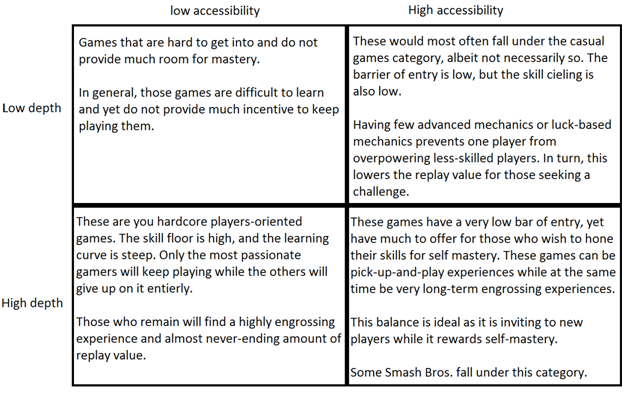
This position assumes that depth and accessibility are two different ends of a spectrum. If the game gets deeper, the game becomes less accessible, or vice versa. However, those two concepts are in fact quite separate and there are more gray areas than one might initially believe. We can divide these in four simple categories for easier understanding, but this is just to demonstrate the idea:


An ideal game attempts to maximize both its accessibility and its depth. If we are arguing on the point of inclusiveness, then in stands to reason that going into the high accessibility but low depth end of the spectrum, you lose a part of your audience; the competitive audience. On the other hand, if you go on the low accessibility and high depth of the spectrum, you lose your entry level gamers. However, maximizing depth and accessibility will allow for less experienced players to enjoy the game at a surface level while allowing for self-mastery. This would be the more inclusive solution.


Argumentum ad verecundiam (argument or appeal to authority):

“This fallacy occurs when someone tries to demonstrate the truth of a proposition by citing some person who agrees, even though that person may have no expertise in the given area.”

It is the assertion that a claim is true or false or good or bad because an authority says so. The authority in question may be a person, a book, an organization or anything that may be perceived to be knowledgeable about a certain topic at hand. In this case, the authorities most often cited are Nintendo and Masahiro Sakurai whom were responsible for making the series. Some using the appeal to authority fallacy might be tempted to say that Nintendo is an authority on game design and if they say that games should be designed in a certain manner, then it stands to reason that this is the way to go. However, this fails to take many things into consideration. It fails to take into account the less successful ventures that the company has taken and it fails to take into account the entity’s possibility of committing a mistake despite ample evidence of it happening before. It also fails to consider that other authority figures who have just as much experience in that field disagree. One could ask Yoshinori Ono or Daisuke Ishiwatari's oppinions on the best way to balance a fighting game, and they might completely disagree with how Masahiro Sakurai operates. Finally, it fails to take into account that the relationship between the video game company and the consumer is one of seller and client and that most of the dialogue will be tainted by corporate marketing tactics, which is not completely honest.

Appeal to authority can be somewhat valid in say... a scientific argument. One could say that the statements of Carl Rogers on humanistic psychology are more likely to be valid than those of a random talk show host. However, in the case of designing video games, while authority figures can comment on various technical aspects of game creation such as modelling, animations and coding, the fact remains that video games are an interactive experience and that controlling for each individual’s experience with a game is impossible. Each and every person will bring part of themselves into the game. Their interpretation of the story, their appreciation of various mechanics and how they approach and decide to pay attention to different aspects of the game makes playing a video game into a very personal experience. In other words, when it comes to video games, there is no “quality”, there is only “individual perceived quality”.

As such, one ought to want to maximize perceived quality for as many parties as possible. In the case of Super Smash Bros., competitive players argue that giving competitive players the tools they need to have a good time is a good solution in this direction as it would allow the game to be playable at both a competitive and party level. Those who argue that competitive play should be removed from the series as a whole are aiming to lower the aggregated perceived quality of the franchise.


The “Nostalgia goggles” argument:

This is a very frequent thing I’ve been seeing these days. It is not a secret to anybody that I do not enjoy The Legend of Zelda Skyward Sword. I find that I have been much too generous with my already scathing review of this game in retrospect. Nevertheless, while I was discussing this game and how I felt that I much preferred the control scheme and exploration aspect of the older games, I kept being told “You just have nostalgia goggles”.


I had valid arguments. Those who do not like using motion controllers would naturally prefer the older games. Left-handed players are also at a disadvantage. Furthermore it is a fact that the older games in the series placed more emphasis on exploration and towns and locales. My opinion was based on very logical reasoning and nostalgia had nothing to do with it. I noticed later on that this argument was being used very liberally with Super Smash Bros. “You just prefer Melee because of nostalgia”. It really struck me how non-conducive to a healthy debate that is.

Painting someone as being nostalgic is an effective way to attempt to discredit their opinion. They paint them as biased and thus everything they say is wrong. However, many things must be taken into account. Being nostalgic does not make your arguments wrong.

By definition, nostalgia is sentimentality for the past, typically for a period or place with happy personal associations. In other words, you are feeling nostalgia toward a game because it had a profound positive impact on you. Arguably, a good reason for a game to have such an effect on you could simply be that it was a very good game. It may be that this older game did certain things better than the newer game. I see many people argue that the latest smash that came out is the best because it’s new. Smash games have changed very drastically over time and went in all kinds of directions. The reality is that there are people who don’t actually care all that much about how the game plays; they just want the new game. Whatever is newest will be best to them, regardless of inherent gameplay quality. We call this recency bias. The nostalgia goggles argument they use is invalid and toxic to any argument.


Argumentum ad antiquitatem (the argument to antiquity or tradition):

This is the familiar argument that some policy, behavior, or practice is right or acceptable because "it's always been done that way."

Some non-competitive smashers appear to believe that because Super Smash Bros. Was initially played as a party game and that competitive Smash came after, competitive players have no right to request a more competitive-friendly experience. For example, many will repeat “You should play Smash the way it was meant to be played”. However, such thinking does not take into account that a game’s metagame evolves over time and that tradition is not a justification for not growing with the times. It also doesn’t consider that the author’s intent is irrelevant. Games being interactive by nature makes each person’s interpretation and experience with the game different. An author loses interpretative ownership of his work once it leaves his hands. Furthermore, the fact that games are products meant for consumption first and foremost implies that consumers are and should be free to make demands of whoever is creating these products.


Argumentum ad hominem (argument directed at the person)

This is by far the most prevalent argument used by a large subset of non-competitive smashers. “This is the error of attacking the character or motives of a person who has stated an idea, rather than the idea itself.

For example, the person may attempt to put the competitive smasher in a stereotypical box. “Elitist” is a word that gets thrown around a lot. While competitive smashers know that this stereotype is a fabrication, even if it were in fact the truth, it would not remove any validity from their argument whatsoever.

Ad hominems are easily destroyed as the point of a debate is to determine the validity of an argument, not the quality of the other party’s character.


Argumentum ad ignorantiam (argument to ignorance)

This is the fallacy of assuming something is true simply because it hasn't been proven false.” This argument is sometimes used to argue that we cannot prove that advanced techniques will not deter from the casual player’s enjoyment of the series, therefore, it would. However, this by itself is not a valid point. In a court situation where everything is dependent on the burden of proof, a prosecutor could never be taken seriously if he stated “The defendant has no alibi, therefore, he is the culprit”. The inability to prove a point does not in fact prove the contrary to be right.

Furthermore, the competitive community has evidence of a competitive friendly game that was enjoyed by the casual market in the name of Super Smash Bros. Melee. This was the best-selling game on the Gamecube and enjoyed by all kinds of people before a competitive scene even existed for it. It also has further evidence with many party smasher testimonies stating that they enjoy Project M. In light of these arguments, the burden of proof shifts to the other side.


Argumentum ad nauseam (argument to the point of disgust; i.e., by repetition)
 
“This is the fallacy of trying to prove something by saying it again and again.”

Often, you will argue with a less open-minded non-competitive smasher and drive him into a corner where he will not have any more arguments. At this juncture, he will repeat the same thing over and over again. “Project M is not a real game!”. “Smash is meant to be played casually!”. These arguments are repeated over and over again like some sort of cultist chant, as if repeating them will alter the paper thin nature of the argument. No matter how many times you repeat an argument, it will not become more or less true than it was when it was initially presented.

Nevertheless, this fallacy is very popular as the more you repeat an argument; the more likely third parties are to remember it. For example, many actually still believe that competitive smash players only play on Final destination and only use Fox. That came from an inaccurate meme by Kirbopher on Newgrounds (who was not very tolerant of competitive players to begin with, and had no experience going to tournaments whatsoever at the time) that stated: “Fox only, no items, Final Destination”. And so, many wrongly believe that Super Smash Bros. 4’s For Glory mode is actually something the competitive community actually wanted. This misconception was made popular through repetition. However, repetition alone is not a substitute for a valid argument.

Any person who had even a minimal working knowledge of how competitive Smash works would know that a wide variety of stages are used and that much of the cast is represented in tournament play. They would also know that many do not favour Final Destination as it provides an edge to characters with high ground mobility and long-range projectiles.

If you want an example of this fallacy being used in popular culture, Mr. Mackey in South Park provides an excellent example. Observe how he keeps stating “Drug are bad, mkay?” Now, his point may be correct, and I will leave you to be the judge of that, but all he does is repeat the same assertion over and over again without providing any evidence. If you want your argument to stick, you need to elaborate.


Argumentum ad numerum (argument or appeal to numbers)

“This fallacy is the attempt to prove something by showing how many people think that it's true.” In the party smash community, it seems to be a common thing to state that because the majority of smashers are party smashers, their way to play is the only way to play, ergo, competitive players have no right to complain because they are playing the game wrong, and because many agree with them, they are right. However, no matter how many people believe something, it doesn’t necessarily make it true.

Most individuals still believe that bullying has no bearing on the mental development of a growing child despite mountains of research stating the opposite. Tons of individuals still don’t believe in evolution despite ample evidence of it existing in scientific literature. A majority of people can very much be wrong. This is also similar to argumentum ad populum that basically states that an argument is valid because it is popular. More... fanatical fans of Nintendo who use this argument ought to be careful, because if majority opinions are to be believed, the Wii U they love is a bad system.


Complex question:

“A complex question is a question that implicitly assumes something to be true by its construction”. An example I once heard went like this “Do you enjoy disrespecting all of Sakurai’s work?” This question assumes something that was never said to be true. It assumes that I disrespected his work, all of it to add to that.

This tactic is often used to shift the discussion into an ad hominem attack, or to attempt to discredit the other party. In a court situation for example, a prosecutor could say “Did you stop beating your wife?” It assumes the accused beat his wife in the first place.


Cum hoc ergo propter hoc (with this, therefore because of this):

“This is the familiar fallacy of mistaking correlation for causation -- i.e., thinking that because two things occur simultaneously, one must be a cause of the other.” Many have argued that Project M’s arrival killed Brawl’s competitive fanbase. This assumption is being made because the popularity of Project M is inversely proportional with the popularity of Brawl. Project M is becoming more and more mainstream whereas Brawl’s scene is dying out. Some take heavy offense to it, blaming Project M for the impending death of their favoured Smash game.

However, the problem is that two things may happen together by mere happenstance. One could argue that Project M keeps releasing more and more content and interest in it is growing. Furthermore, the media has begun covering it more and more, and that means that more people are aware of its existence. Finally, Playing Project M does not block you from paying other games in the series.

It may be that Brawl merely did not have the strength to stand on its own legs as its own competitive esport. Perhaps the real reason some players moved on to Melee and Project M is because Brawl failed to keep them captivated and they looked elsewhere for entertainment. You may believe that Factor A (Project M) caused the descent of Factor B (Brawl). However, it may be that Factor B caused the rise in Factor A. Genuine disinterest in Brawl may have paved the way for more Brawl smashers discovering Project M. It may even be that an unrelated factor caused this to occur. Correlation does not imply causation.

While I have heard it from competitive Brawl players, it is interesting to note that the majority of individuals who have given me this argument are party smashers who are not part of the Brawl tournament scene.


Dicto simpliciter (spoken simply, i.e., sweeping generalization):

This is the fallacy of making a sweeping statement and expecting it to be true of every specific case -- in other words, stereotyping. In the smash community, we unfortunately have to walk on egg shells. There will always come a time where one representative of the competitive community will have enough of the verbal abuse and lash out. When this happens, people will jump on that person’s statement and use it as an example of why all competitive smashers are elitist jerks.

However, one person can hardly represent an entire community. It is important that whoever makes sweeping generalization be called out on it. One elitist does not make an entire community elitist.


Red herring:

“Introducing irrelevant facts or arguments to distract from the question at hand.” Let’s say that I argue that a game should be fun for everyone, competitive and non-competitive alike. Someone may respond “But this is not Sakurai’s vision”. This is irrelevant to the discussion at hand.

This person is not discussing the matter at hand, which is whether it is appropriate or not to have a game that is fun for both part and competitive smashers. Instead, he shifts the topic about the how to reach a compromise in the smash community to what he believes are the wishes of the creator of the series.


Slippery slope:

“A slippery slope argument is not always a fallacy. A slippery slope fallacy is an argument that says adopting one policy or taking one action will lead to a series of other policies or actions also being taken, without showing a causal connection between the advocated policy and the consequent policies.”

A common argument I hear is that if Smash games have advanced mechanics, then people will stop buying them and the series will die. However, there is absolutely no evidence that this would in fact occur. If anything, Melee sold very well taking into account the system’s lack of popularity. The attach rate for this game is extremely high. Project M is being played casually in many homes.

Yet again, the opposite has been seen where depth was removed from a game and it started performing worse as a result. Final Fantasy XIII was critically detested by most for removing player choice despite its inherent simplicity.

There is ample evidence that this argument is fallacious.


Straw man:

This is the fallacy of refuting a caricatured or extreme version of somebody's argument, rather than the actual argument they've made. Often this fallacy involves putting words into somebody's mouth by saying they've made arguments they haven't actually made.

For instances:

Debater 1: I feel that smash games should be competitively viable. Wavedashing was great, it added so many options. I wish they brought back Melee’s advanced techniques.

Debater 2: You are so entitled. You just want Nintendo to make a game just for you. Filthy elitist.

The one who responded to the initial statement could not take down the argument of debater 1 as it was, so he turned it into such an exaggeration that it became possible to knock it down. Debater 1 did not imply in any way that he wants to prevent party smashers from having any content directed at them, far from it. All he wishes is to have a fast-paced game that rewards offense and had advanced techniques from the older games in the series. He is not asking for items to be taken out. He is not asking for all stages to be neutral. He is not asking for a game that is made with just himself in mind. He is expressing an opinion and a valid concern.


Conclusion:

I am one who firmly believes in having options for everyone. Gamers need to learn to excercise tolerance to the taste of others, but they also need to shy away from fanatical behaviour toward an entertainment company. Video game corporations love you as far as they can reach into your wallet, and as consumers, I think we are shooting ourselves in the foot by blindly giving ourselves up to them. Critical thinking is a great tool and it should be used to further our own consumer interests.

Also, let's not be like this guy:

Credits to MegaMissigno for showing me that image.